
The rain came during the night. I awoke to hear it falling on the flysheet of the tent. I emerged in the darkness, and gathered up my things. I took down the little tent. There was a recreation building on the campsite, very close to where I had camped, and I brought everything there. I packed everything and got ready for the road. My cycling German neighbours had not stirred by the time I was ready to go out on the trail.
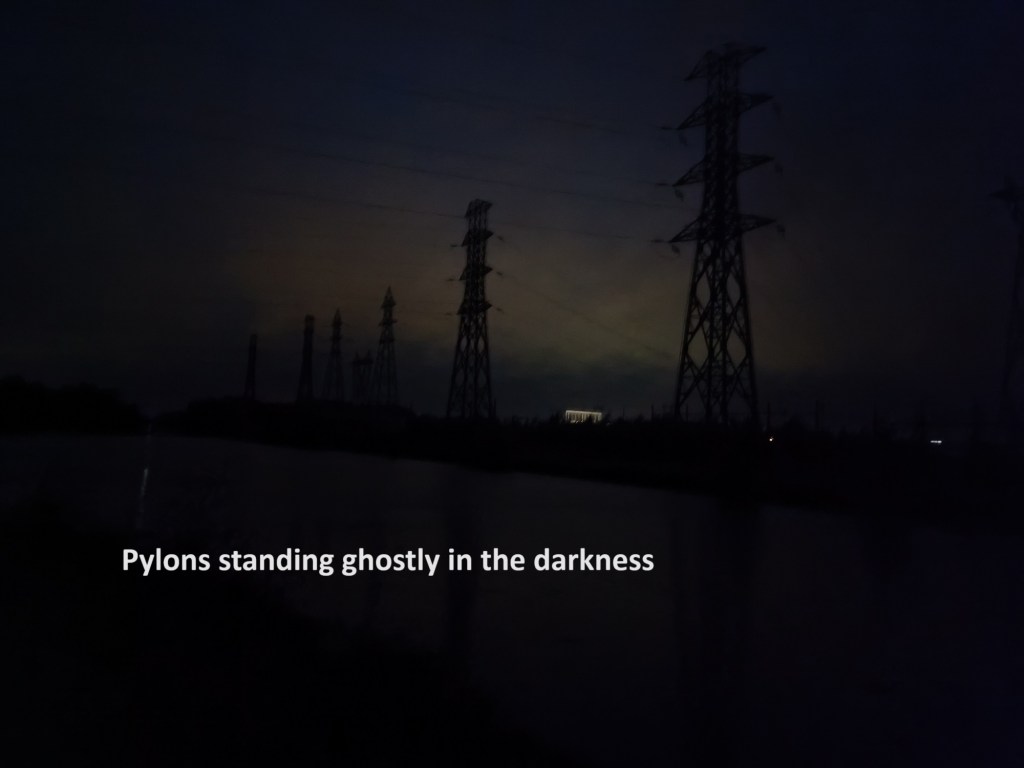
There was a short distance on the road before I turned off onto the path alongside a canal, the Canal de la Sambre a l’Oise. It was still dark, and the electricity pylons on the other bank of the canal looked like monsters in the faint light that was available.
The canal is part of a large network in this part of France, and it is possible to bring a boat all the way to the Netherlands. This section that I was walking was built as part of the Canal de Saint Quentin project. The canal was the scene of some of the last battles of WW1, which included the death of the poet Wilfred Owen.
I reached Beautor, where there is a café. I had to wait for it to open before I could have my breakfast. It was still raining. The official route goes on from Beautor to La Fere. It goes around in what looks on the map like three quarters of a circle. I had wondered why the guidebook did not suggest a shortcut that would just take the remaining quarter of that circle. I decided to give the potential shortcut a try. To do this, I headed south on the D553 road, which bears the name Grand Rue, though it is really just a village street with very little grand about it. There were very few cars on the Grand Rue as I went. That brought me to the junction with the D1032. That road doesn’t carry a name but was much busier than the D553. An almost constant stream of cars and heavy lorries went past as I made my way eastwards for about two kilometres. And then I found out why the guidebook would not recommend a shortcut. Where the D1032 crosses the official trail, they are at different levels. The trail actually goes under the D1032. I had to get over the roadside barrier and scramble down an embankment to get back on the trail. It wasn’t a very high embankment, and not difficult to go down. But it does present reason enough for the guidebook not to consider that shortcut. And it was still raining.

The rain seemed to ease somewhat as I went through the village of Andelain. But I realised later that was simply the weather gods playing with me, giving me false hopes only to dash those hopes later. The trail did not go into the next village, Bertaucort-Epourdon, but skirts around the edge. It was only a very short distance from there to Epoudron, where the guidebook did suggest a shortcut. In the rain, I would take any shortcut I could get. The guidebook suggests following the road, designated D55, through the village of Missancourt and on to the village of Saint-Nicholas-aux-Bois. I followed the shortcut. It was a quiet road, very different from the D1032 earlier. None of these villages presented anywhere like a bar or café that a man could get refreshments, and so I kept going through both. Not long after Saint-Nicholas-aux-Bois, the road rejoins the official trail. Or perhaps I should say that the official trail joins the road, as the road becomes the official route, continuing southwards. That way, I reached the junction between the D55 and the D7 meet. And it was still raining.
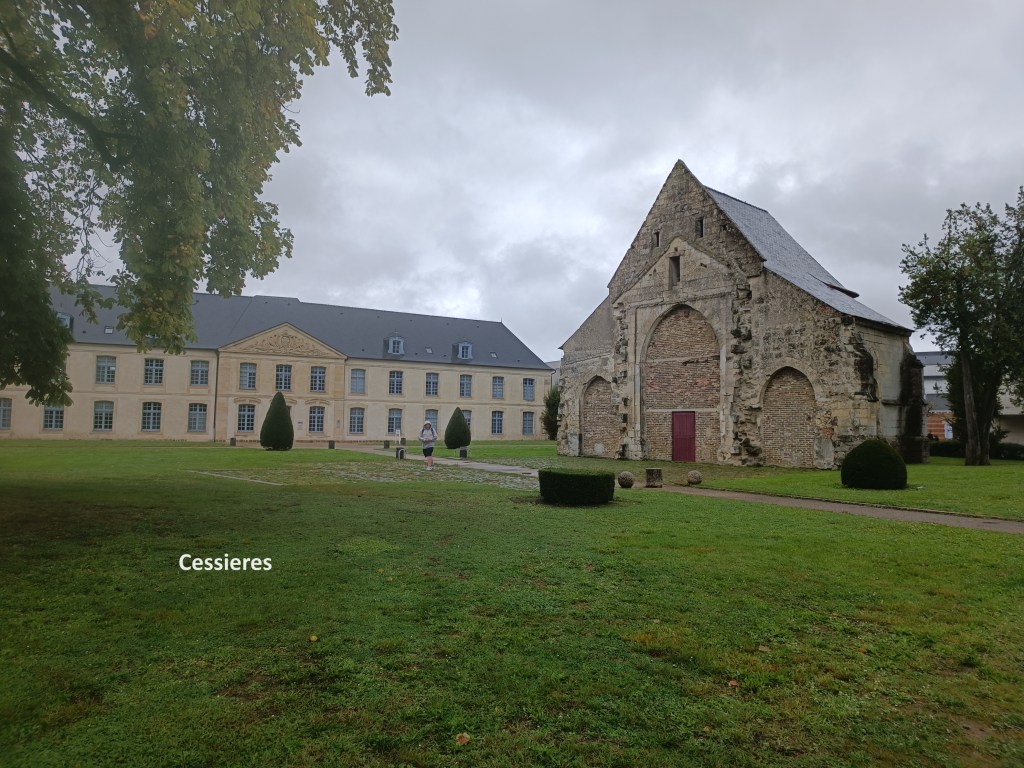
A signpost at the junction said that it was just four and a half kilometres to Cessieres, and only fifteen kilometres to Laon, my destination for the day. That lifted my spirits somewhat. The total distance from Tergnier to Laon is given by the guidebook as just under thirty-nine kilometres. My shortcuts would take maybe six kilometres off that, so I was at least halfway through my journey. But it was still raining. The trail follows the D7 road for about two kilometres, and then goes into the woods on the southern side of the road. It then continues, following very close to the road, even touching the road at one stage, to reach Cessieres. I decided to follow the road. Traffic was light, and the road would be drier than the forest paths. About an hour later, I reached Cessieres, which is a fairly substantial village. I walked on through the village, finding nothing open. It was still raining.
I continued on the D7. The road and the trail still go in a similar direction, though there is a bit more distance between them; they get to a point where they are about one kilometre apart as they make their way to Laon. At each junction on the road, I counted down the distance to Laon. I went on through La Neuville. There, I joined up again with the official trail, which follows the D7 for a little over one kilometre to Montreuil. The trail and the D7 continue on almost due east towards the train station in Laon where the trail turns southwards into the old town. However, I took a shorter route south-eastwards. And just as I was coming into Laon, the rain stopped. It was as if the weather gods had given up the fight. They had sent rain all day, and it had not stopped me. But while my raingear is good, it is not that good, and by now I was quite wet.
I trudged up the hill into Laon. Laon was one of the places on the route where it had been difficult to organise a place to stay, but I had booked accommodation in an apartment in the old city. The old city is on top of a hill. The steep walk up the hill reminded me of the cathedral steps in Le-Puy-en-Velay, but there it had been early morning and I was fresh, whereas in Laon, I was after walking all day, and I was quite wet. It was tough going to get up that hill and reach the old city. But I got there and let myself into the apartment. After a shower and a change of clothes, I felt much better.
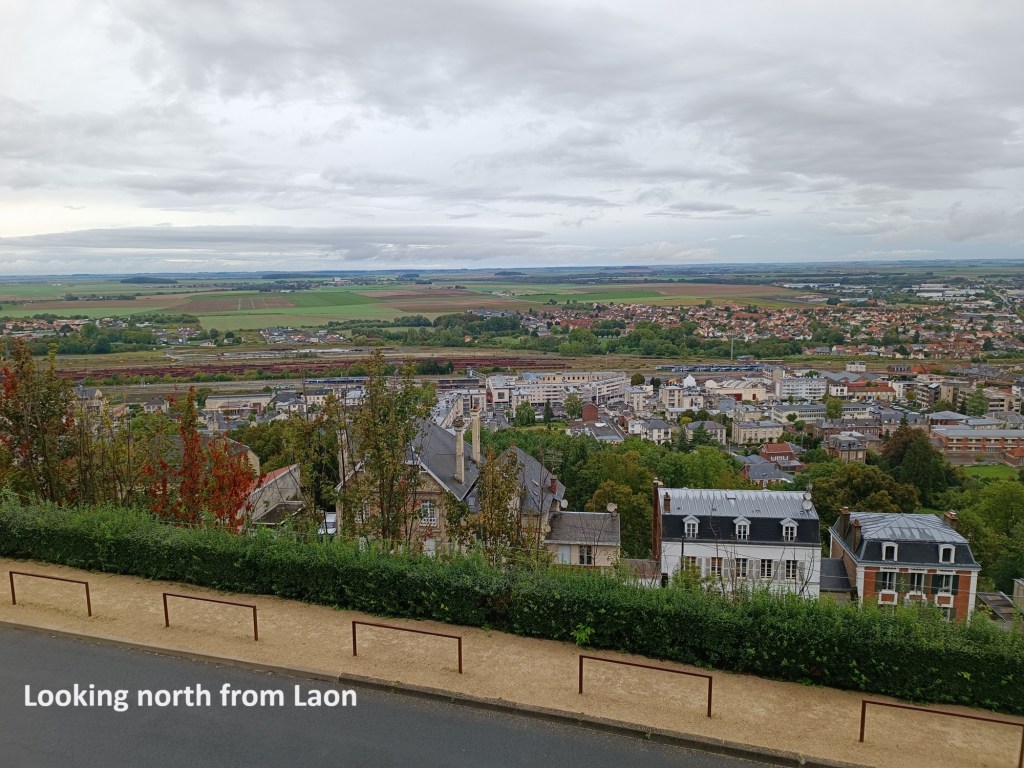

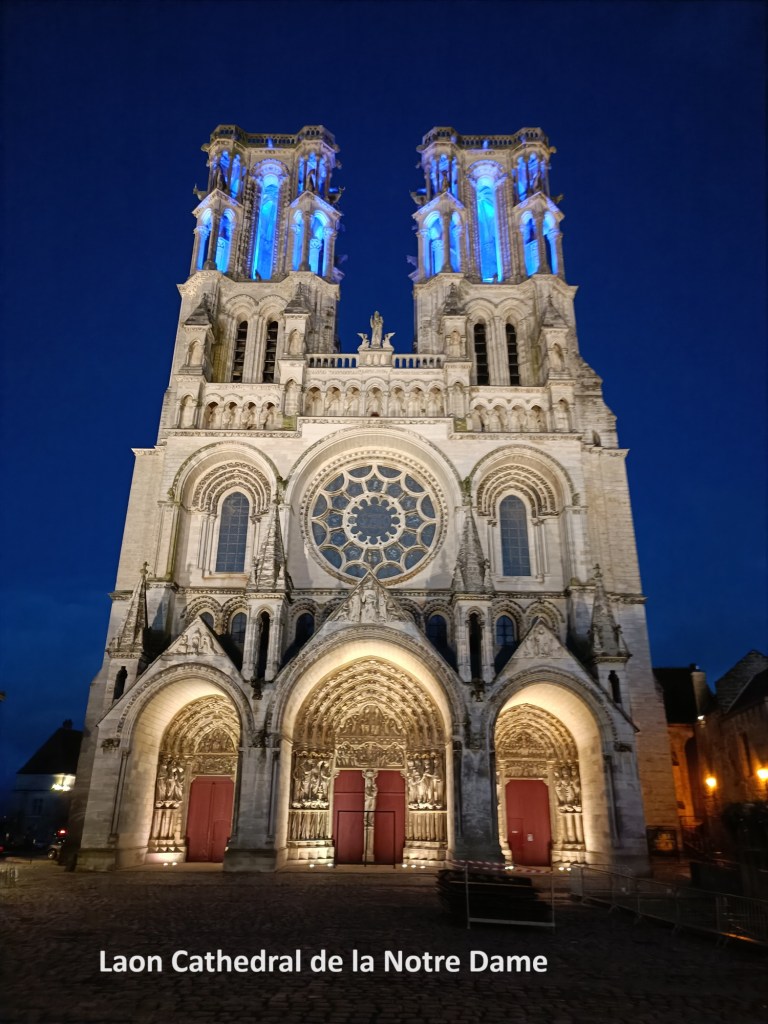
One of the phenomena of modern times is the number of roadside mini-launderettes that have sprung up in so many towns of the world. I found one of those, and soon my wet clothes were clean and dry again. Then I could walk around the old city. Laon is dominated by its cathedral, the Cathedral de la Notre Dame. The current building was built in the twelfth and thirteenth centuries. It is a beautiful building, but behind the façade, there is significant renovation going on. Laon was occupied by the German army in August 1914, and remained in German possession throughout the war, though there were battles not far away. As a result, it was spared the destruction that Amiens, Saint Quentin, and Reims suffered. It is the ravages of time that the renovators face in Laon.
When evening came, I went out to get something to eat. An excellent dinner, washed down with a few bottles of local brew finished off my day. Then it was time to go back to the apartment and rest to be ready for the morrow.

 Walkingman