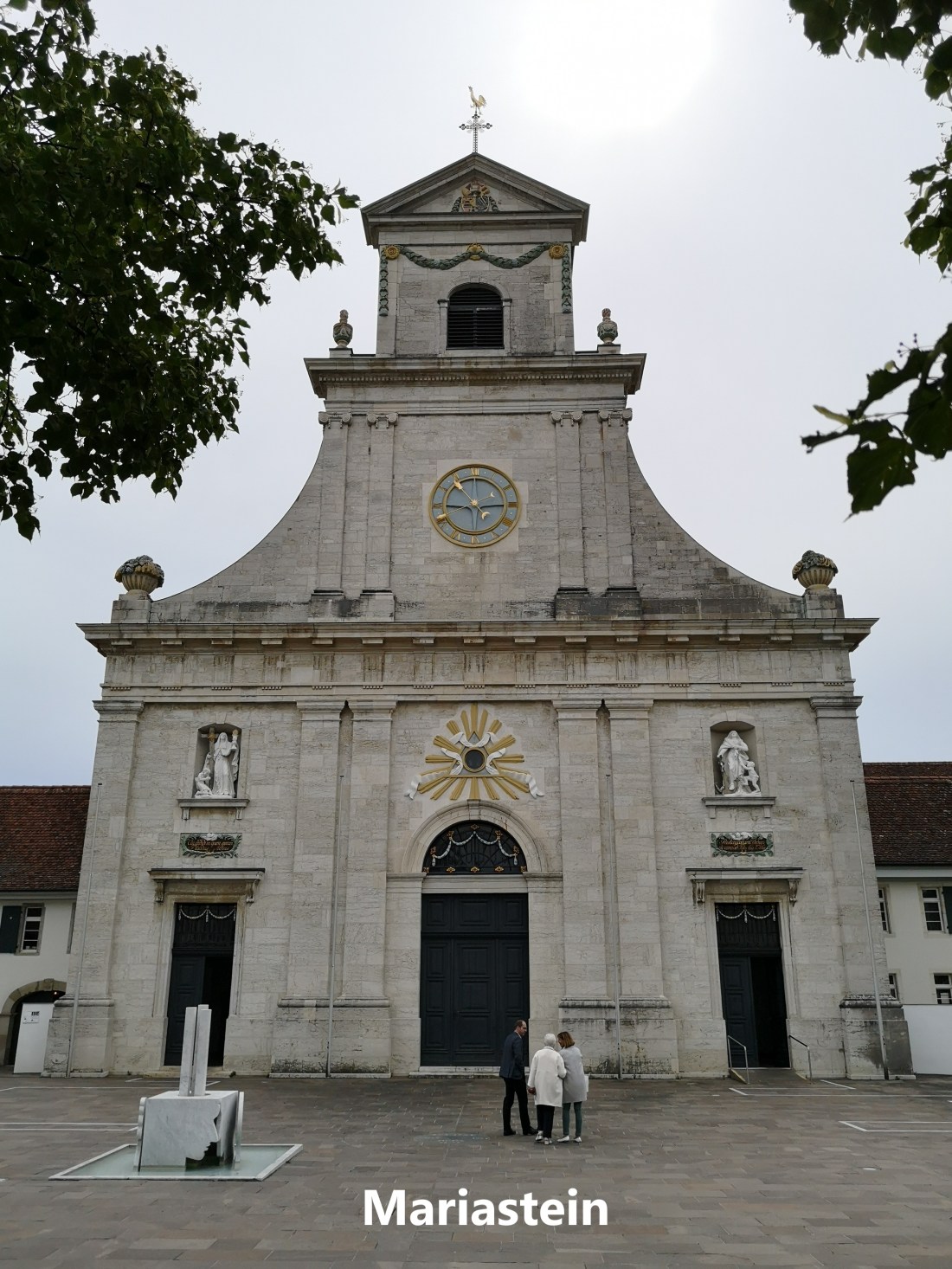
It may seem odd, but in ten years of living in Basel, I had not visited the monastery of Mariastein. The monastery is a place of pilgrimage in its own right, having been the scene of several reported miracles in the 15th and 16th centuries. And it is only about 20km from Basel, accessible by the city’s public transport system. I guess I just never got around to it. It didn’t seem to fit in with my various walking projects, so for ten years it has not been high on my priorities.
But recently, I decided on a new walking project which brings Mariastein into my plans. As will be known to any who read these posts, I have been preoccupied with the pilgrimage route to Santiago. The feeder routes to Spain form a network of pathways all across western Europe. The official Swiss route starts at Konstanz in the north east and runs down to the French border near Geneva in the south west. There is a spur that starts in Luzern, goes through Bern, and joins with the main route at Rüegisberg. I have walked that route from Luzern to the French border, something I will come back to another day. However, when going across the border from Basel into Germany, I have often seen route markers with the shell symbol in the Rhine valley, and I have occasionally seen backpackers in Basel with the shell symbol on their rucksacks. I have often wondered how those pilgrims going through Basel joined up with the main Swiss route. It turns out that as well as the official Via Jacobi, there are several other routes. They are not treated as a Via Jacobi by the organisation that manages the waymarked trails, but they appear to be used by pilgrims. From Basel there are two. One goes almost due south from Basel, through Laufen, and joins the official Via Jacobi in Bern. The second follows a more south westerly direction out of Basel, passing through Delemont, Biel and Murten to join the official route at Moudon. And this route also goes through Mariastein. I decided to take a closer look at this route.
While many of the stops on this route are listed, the route itself is not well defined, and it is largely left up to the pilgrim to find their own way between the different stops. So I put together a route that I reckoned was the best way to get from Basel to Mariastein on foot.
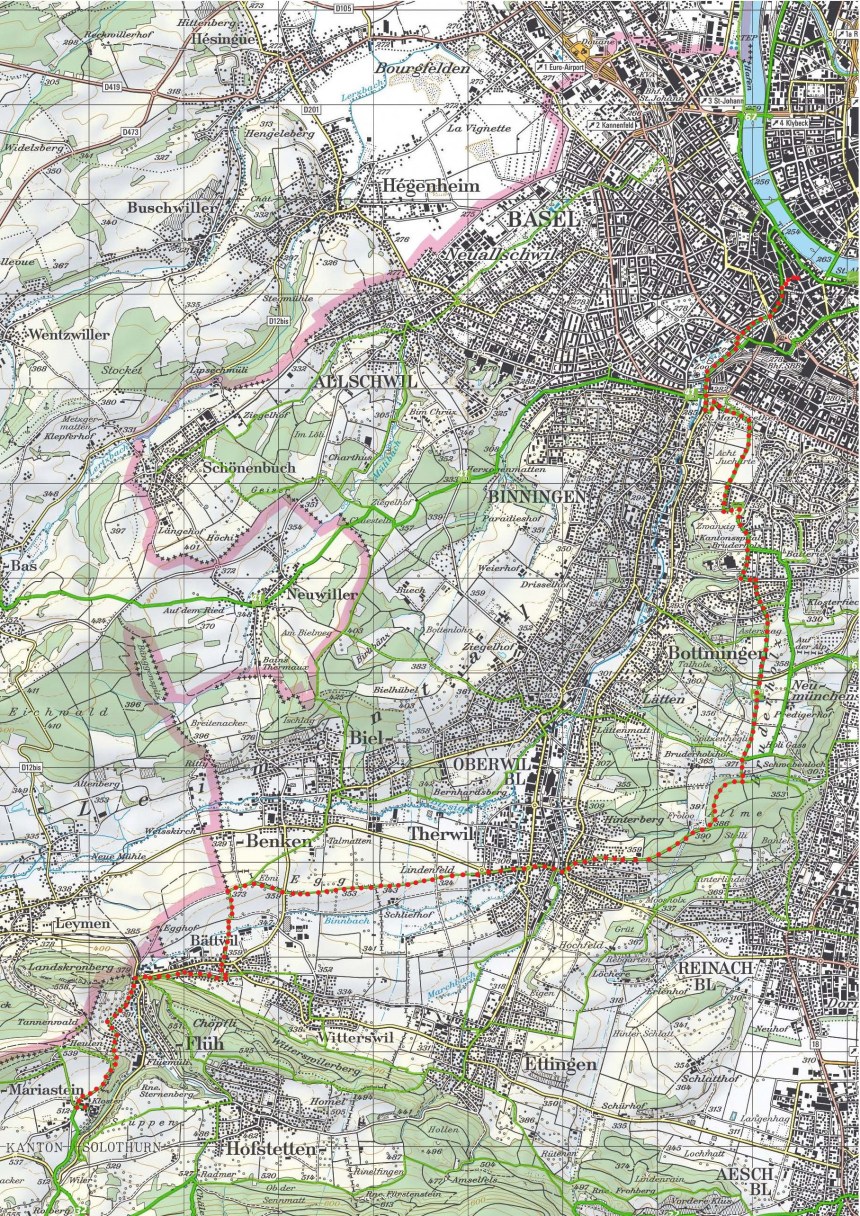
The route has the advantage that it is relatively flat from Basel as far as Flüh. I am already training for my next marathon, so this would be a good test of walking speed and whether I have recovered from the last one. I left the Basel Münsterplatz early in the morning. The day looked fine, but with rain forecast for later, I did not want to waste time.


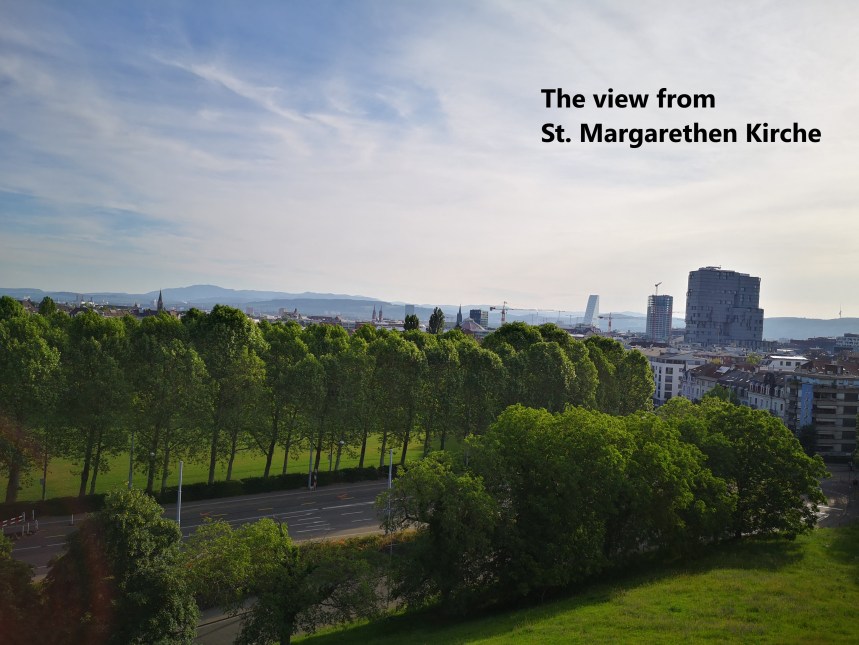
The Basler Münster is in the heart of the old part of the city, but almost immediately I was into the commercial area and walking up Steinenvorstadt, a street of shops, cinemas and bars. But it was all quiet as I quickly left it and went on out past the zoo. A short distance after the zoo, the trail turns off to the left, ascending to the St. Margarethen Kirche. From there, there is a fine view back over the city.
Then the trail took me briefly into the woods before coming out again into open countryside. There were a few suburban streets between the districts of Brüderholz and Bottmingen before I was back into the countryside again, with fields of wheat and barley on either side.


The trail goes back into the woods and swings around to the right before heading westwards into the satellite village of Therwil. Therwil is mainly a residential area for people working in Basel, and I did not see anything of note there, so I went straight through and on out the road to the west, once again with fields of wheat and barley on either side. Perhaps some of those crops will make their way to me either as bread or beer later on. Who knows? The trail turns south and passes some horse farms to reach Bättwil. I saw nothing of note there either, and went straight on to Flüh.


Most visitors to Mariastein go there by public transport, taking the tram from Basel to Flüh, and the bus from there to Mariastein. But I was walking, so I took the trail. It goes uphill steeply from Flüh. Basel is at 254m above sea level; Therwil is at 308m and Flüh is at 380m which is 126m above Basel. Mariastein is at 512m, which is 132m above Flüh. That means that the ascent from Flüh to Mariastein (1.5km) is as much as the entire ascent between Basel and Flüh (14km). But I am a walker, so I didn’t hesitate and just did it.
One of the rewards for walking this way is the chance to visit the Sankt Anna Kapelle, a little to the south of Mariastein itself. This little chapel is situated in trees overlooking cliffs that go all the way down to Flüh. It is a delightful little place, and I would have loved to go in, but unfortunately it was locked.


And so I came to Mariastein itself. Mass was in progress when I got there, and out of respect for the worshippers, I could not go around snapping photos and playing tourist. I will hold that for another day. It has waited this long; it can wait a little longer.


After a brief look around the outside of the monastery, I made my way to the bus stop and home. I was not long home when the promised rain came. My early start was well justified.
The distance from Basel Münster to Mariastein on this route is 15.5km, so it is not really a long walk. And my total steps for the day were 28,827.

 Walkingman
Another good read! I admire your tenacity and doing your passion, you love what you do and do what you love.
LikeLike