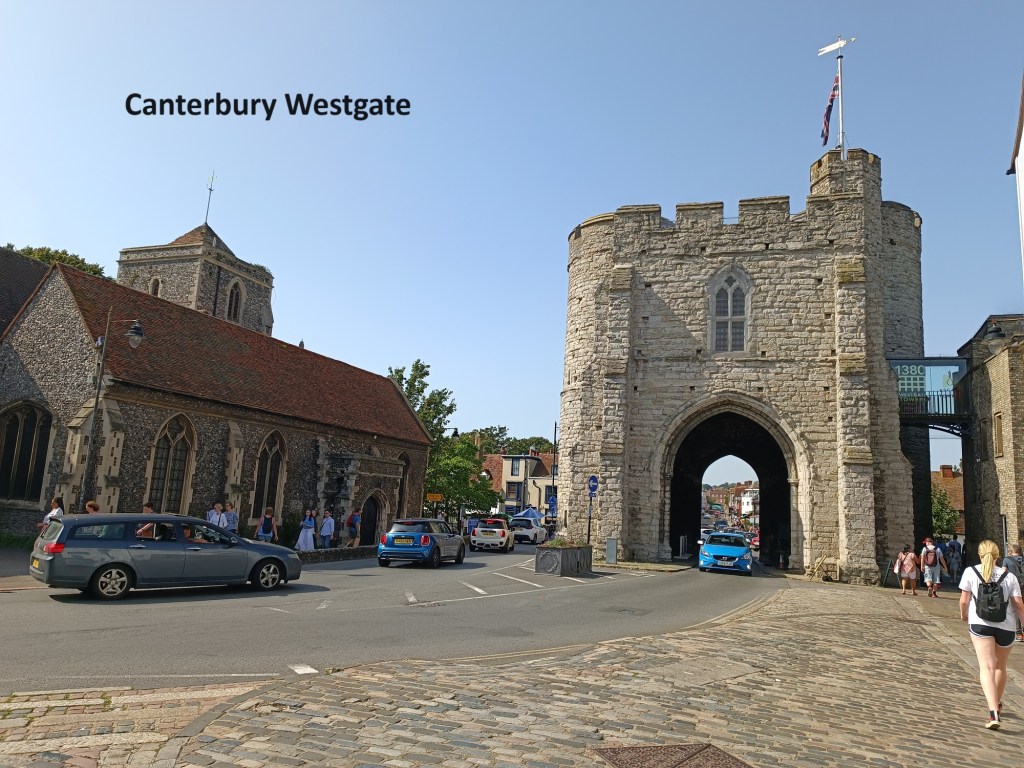
I arrived in Canterbury on 9th September in the middle of a warm sunny afternoon. Summer had not yet given way to autumn, and the town was busy. I went straight from the railway station into the town centre, passing through the Westgate. The gate was built in 1380. Even then, Canterbury was a city of importance. The gate has been modified over the centuries. One of the first modifications was the addition of gunloops in the towers in 1404. Gunpowder had just arrived in that part of the world, though not in widespread use until later.
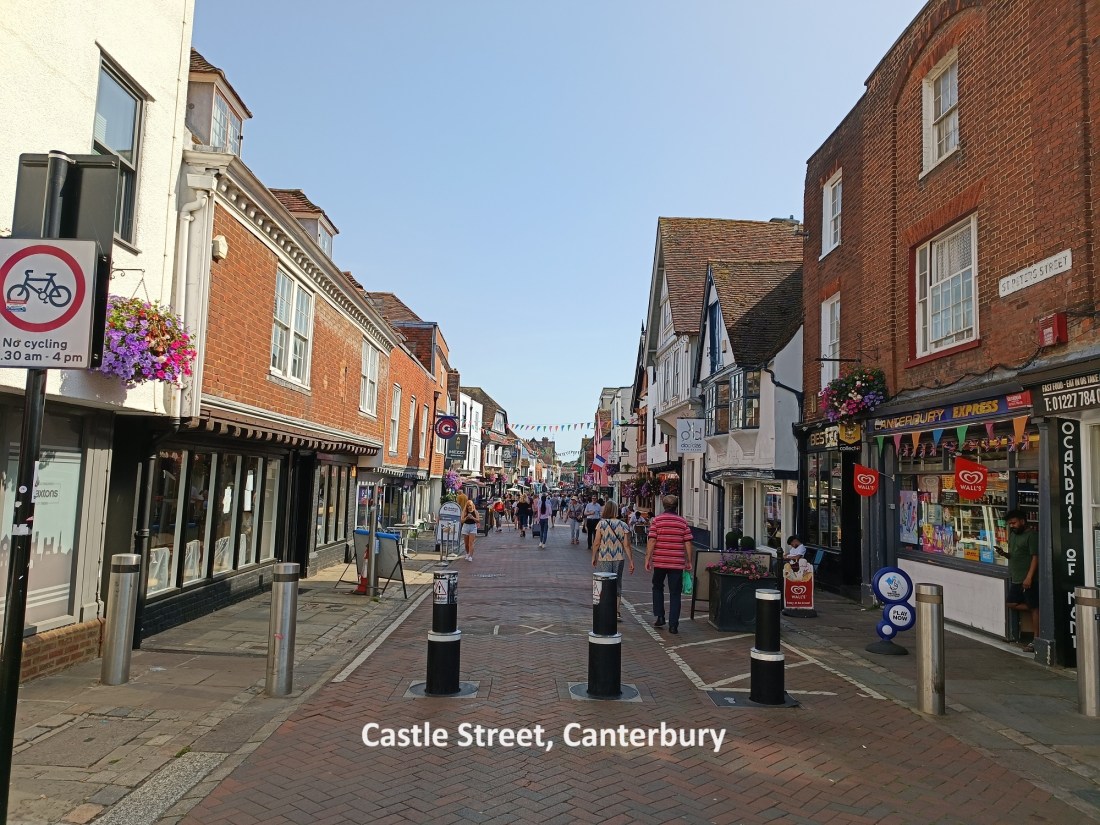
I made my way down Castle Street, to give it its formal name, and turned off to get to the Cathedral. I needed to get my Pilgrim Passport stamped. This is the document that the traveller carries with them as he journeys along the way. It is the confirmation that he or she has actually made the journey. I knew I should get it stamped at the Cathedral, but where at the Cathedral? They were very helpful in the cathedral shop, and told me that I need go no further, that I had come to the right place.
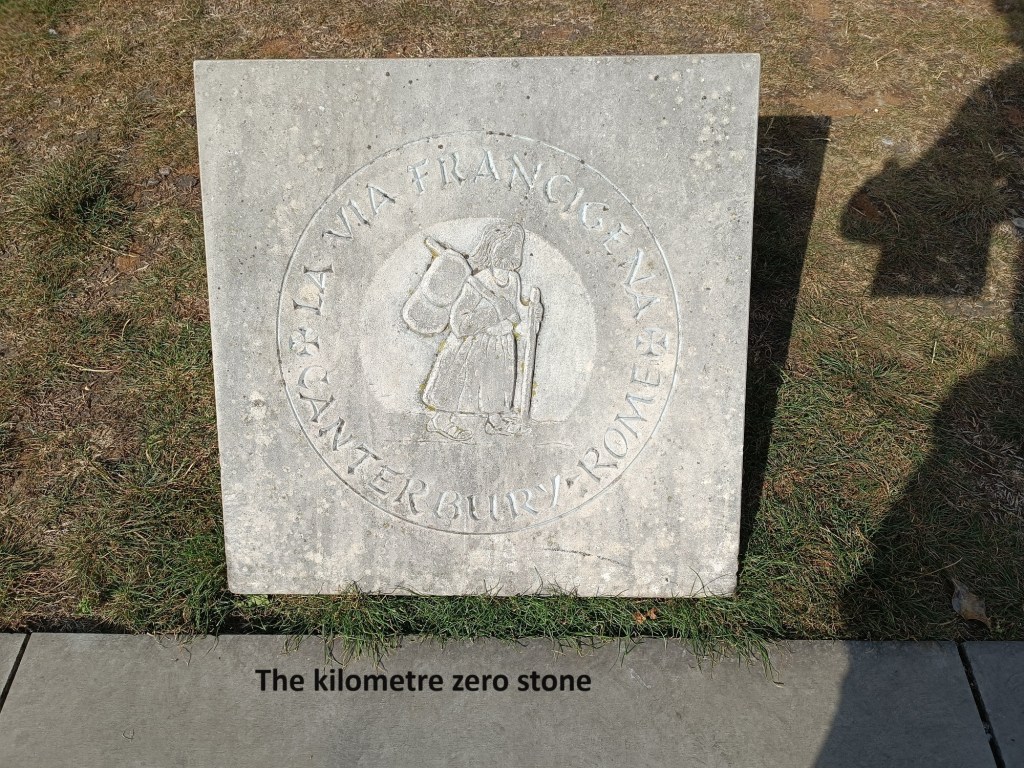
They also told me that my Pilgrim Passport gave me free entry to the Cathedral, so on I went into the Cathedral precincts. There I met one of the security people, or maybe he was simply an attendant there to help the many visitors. I wasn’t sure as to where the actual entrance to the Cathedral itself was, so he advised me, and we started chatting. He showed me the kilometre zero stone, the point that marks the beginning of the journey towards Rome. He also asked me why I was doing the journey, was it for religious reasons, or something else? I explained that it was more a matter of my own personal spirituality and inner wellbeing. That’s what most people say, he told me. He also told me that he runs an Instagram page with photographs of people as they start the pilgrimage. He asked if he could add my photo to the page, and I said certainly, why not. So somewhere on Instagram, there is a photograph of me standing beside the kilometre zero stone in Canterbury. He also advised me that if I was there at five o’clock, as a pilgrim, I would be allowed in to the Evensong service.
I went on into the Cathedral, and after appreciating its magnificent stonework, I joined a small mini-tour group. Canterbury is famous for two people, the author Geoffrey Chaucer, and before that the bishop Thomas Beckett. My guide on this occasion was concentrating on Thomas. It seems that King Henry II wanted someone he could trust as Archbishop of Canterbury, and recommended to the Church that Thomas be appointed. Thomas was reluctant to take it on, as he was not even a priest at the time. But he was persuaded, and once appointed he took the job very seriously. So seriously, in fact, that the previous friendly relationship that Thomas had with the king soon soured very badly. “Will nobody rid me of this troublesome priest?” is the reported question asked by Henry. Several of his knights decided to do some forceful persuasion on Thomas, but he would not go along with that, and in the end, they killed him. It was a major embarrassment for the king, and it did not end well for the knights who had done the deed. Soon after Thomas’ death, reports began to circulate of miracles in his name. People were cured of various ailments, considered incurable. Thomas was canonised as a saint just a few years later, one of the fastest canonisations of the Catholic Church. At the eastern end of the Cathedral is a series of windows depicting some of the recorded miracles. My guide selected a few and told the stories behind them.
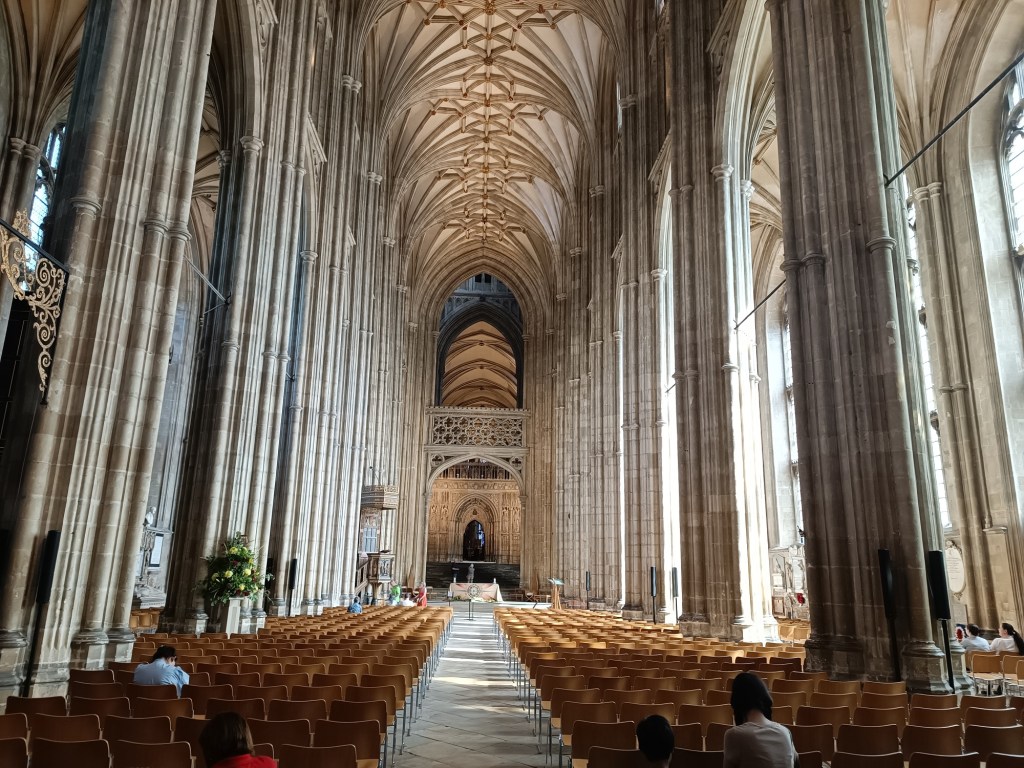
After walking around the Cathedral, I rushed off to my lodgings to drop off my rucksack and come back for Evensong. It is a measure of the status of religion today that the Evensong service is confined to the choir area of the Cathedral, while the main body of the building is empty. I had never attended an Evensong service in any church before, and I found it an interesting mixture of song and prayer. One of the psalms chosen was a bit disconcerting. Psalm 47, which was part of the service, contains the line: “He shall subdue the people under us, and the nations under our feet.” It sounds like a justification for colonialism. The service ended with a blessing. I left with mixed feelings. I felt concerned, as I say, about the choice of psalms on the occasion, though I appreciated the quality of the singing, and the blessing wouldn’t do my enterprise any harm.
After the service, I found a pizzeria, and had dinner before walking back to my lodgings and resting for the night. I had a long walk in prospect on the morrow.

 Walkingman