
The Camino de Santiago de Campostella is well known across the world, and attracts hundreds of thousands of travellers every year. As well as the routes in Spain and Portugal, there are feeder trails from all over Europe, including countries as far away as Poland and Norway.
For medieval pilgrims, Santiago was regarded as the third holiest site in Christianity. The second holiest site was Rome, and the holiest of all was Jerusalem. Whatever about Jerusalem, one would expect a network of official and widely used routes to Rome, similar to the network of routes leading to Santiago. But that has not been the case.
In recent decades, as more and more people have travelled to Santiago, many wanted to follow up with traveling to Rome. This led to an unofficial designation of paths as people went out and marked a route with paint to show the direction to go. Religious communities and local authorities took up the topic and supported the development of the route, though it remained without official status. Then, in in 1994, the Via Francigena was named a European cultural route, and in 2004 as a major cultural route.
In designating the Via Francigena as a major cultural route, that meant that the route had to be fully defined. Many historic figures had travelled to Rome in the middle ages, but most did not record the details of their journey. The exception was Archbishop Sigeric of Canterbury, who travelled to Rome in 990AD and back again. He recorded the journey back from Rome to Canterbury. He travelled about 20km each day and made the journey in eighty stages.
Sigeric’s route has become the basis for the official Via Francigena. Not every last kilometre is exactly as he travelled the route, but the main stopping points are the same. Sigeric probably travelled the main trading roads of the time, roads that have now become major thoroughfares. The official Via Francigena avoids many of those roads, and instead makes its way on farm tracks and forest lanes.
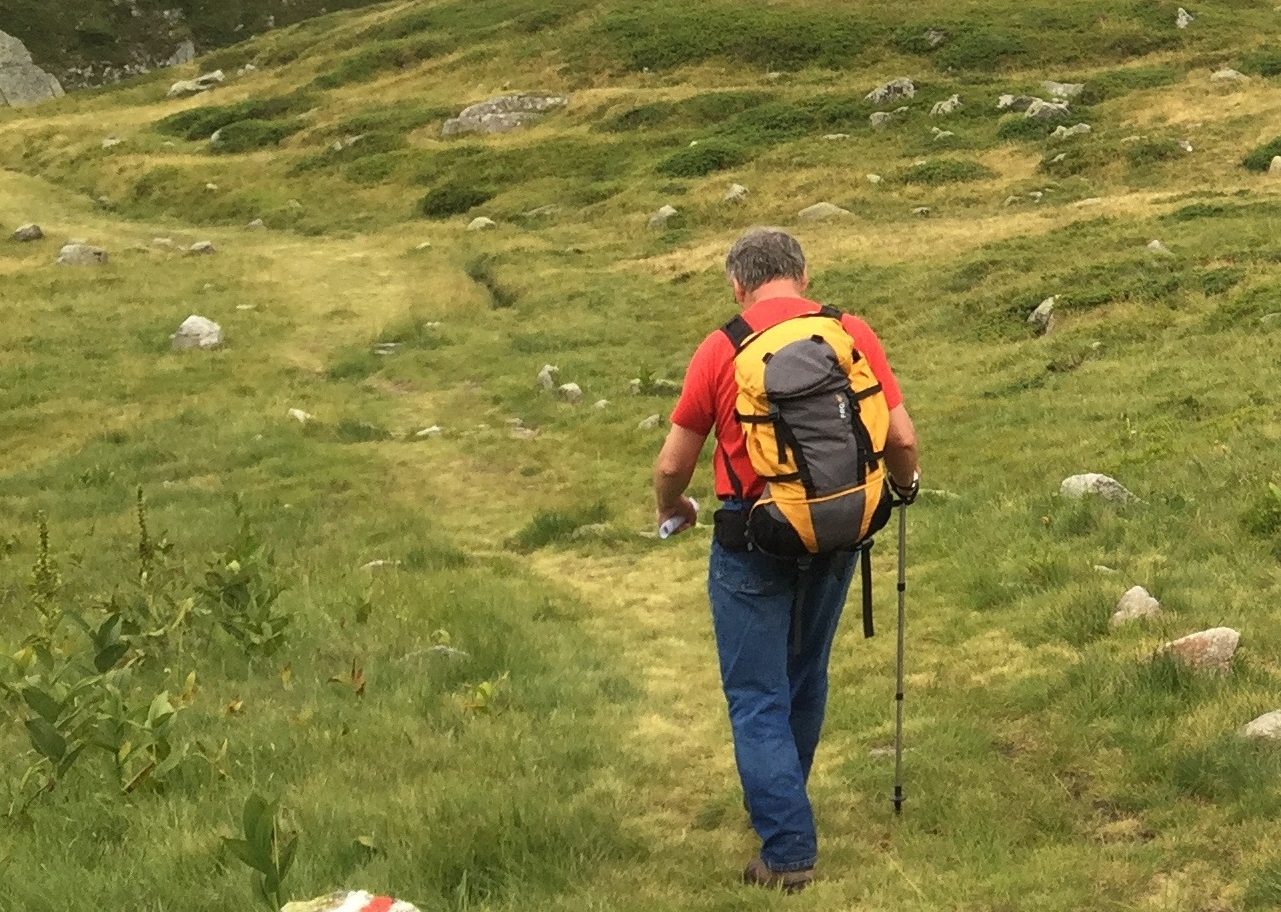
Having completed the walk to Santiago, the Via Francigena was a logical next project for me. As with the Camino, I would not be able to do it all in one go, but I would spread it out over a few trips. And so a while back, I bought my guidebooks, installed the app on my phone, assigned a time in September for the project, and then sat back and did nothing.
But time moves on and does not wait for anyone. In June, I realised that I had nothing done. July was a very busy month in my work, and I did no more than read the guidebooks one more time. But in August, things became urgent, and I booked my flight to London. I also booked my ferry ticket for the travel from Dover to Calais, and I checked out how to get from Gatwick airport to Canterbury. I started booking accommodation. I am inclined to say that the wheels were finally in motion, but a walker does not use wheels. Let’s say that steps were being taken.
Thus it was that I Flew to Gatwick, got a combination of trains to Canterbury, ready to start walking southwards.

 Walkingman