
Stevenson, in his book, describes in detail his leaving Monastier. How he got to Monastier is not described. One can only assume that he came from Le Puy by some conventional means of the time. After taking several days to buy the donkey, get the pack harness constructed, and acquire all his supplies of the journey, it seemed like the entire village was involved in his enterprise. He described how the people of Monastier got great amusements from his efforts, watching the pack harness fall off, laughing at his difficulties with the donkey, and so on. As a result, it was nine o’clock in the morning when he finally left the village.
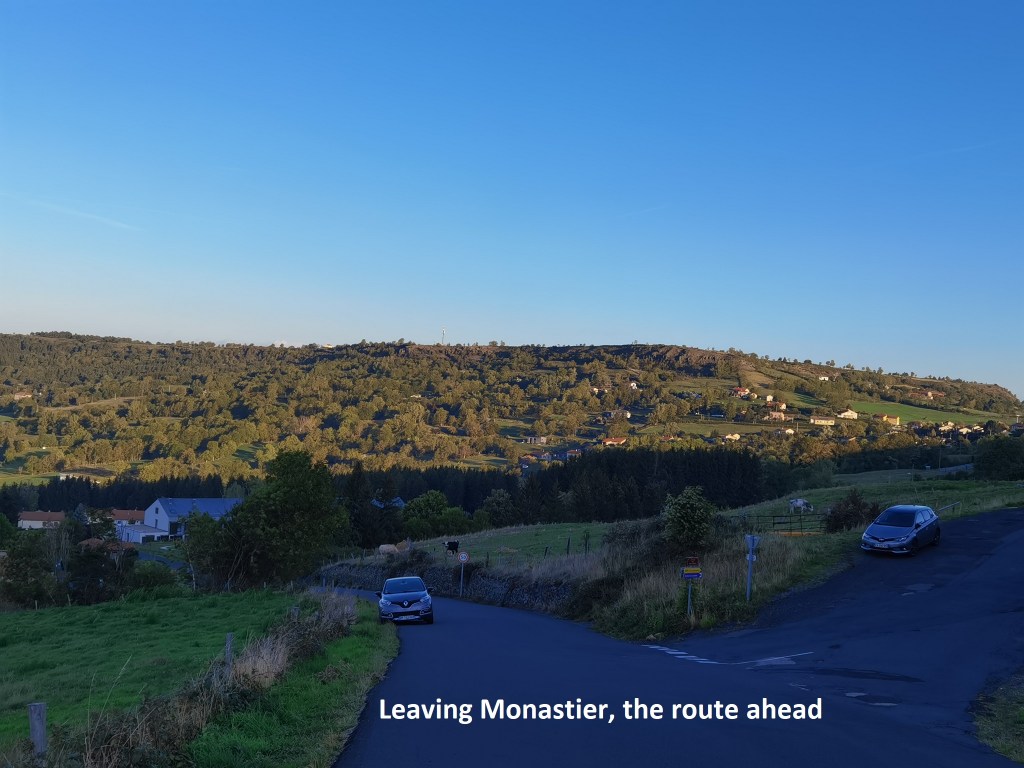
Our departure from Monastier was a quieter process, and somewhat earlier. We, and the other people in the gite, had arranged with the proprietor that we would have breakfast at seven in the morning. After eating heartily, we were on our way by eight o’clock. The weather forecast made allowance for thunderstorms at around that time, but we were greeted by clear skies and cool fresh air. Invigorated by our dinner of the previous evening, a good night’s sleep, and a substantial breakfast, we were ready for whatever the day might bring. The route goes down into a dip below the village before ascending back up into the hills. It wasn’t long before we were on a steep track upwards, but as Joff reminded me, not as steep as the cathedral steps in Le Puy. We passed Jim and other walkers on the way. Jim had stayed in the village campsite, which is in the valley on the way out of Monastier. We told him enthusiastically of our gite experience and the meal of the previous evening. He had dined at the campsite. After the walk from Le Puy, he explained, he did not feel like going back uphill into the village to eat.
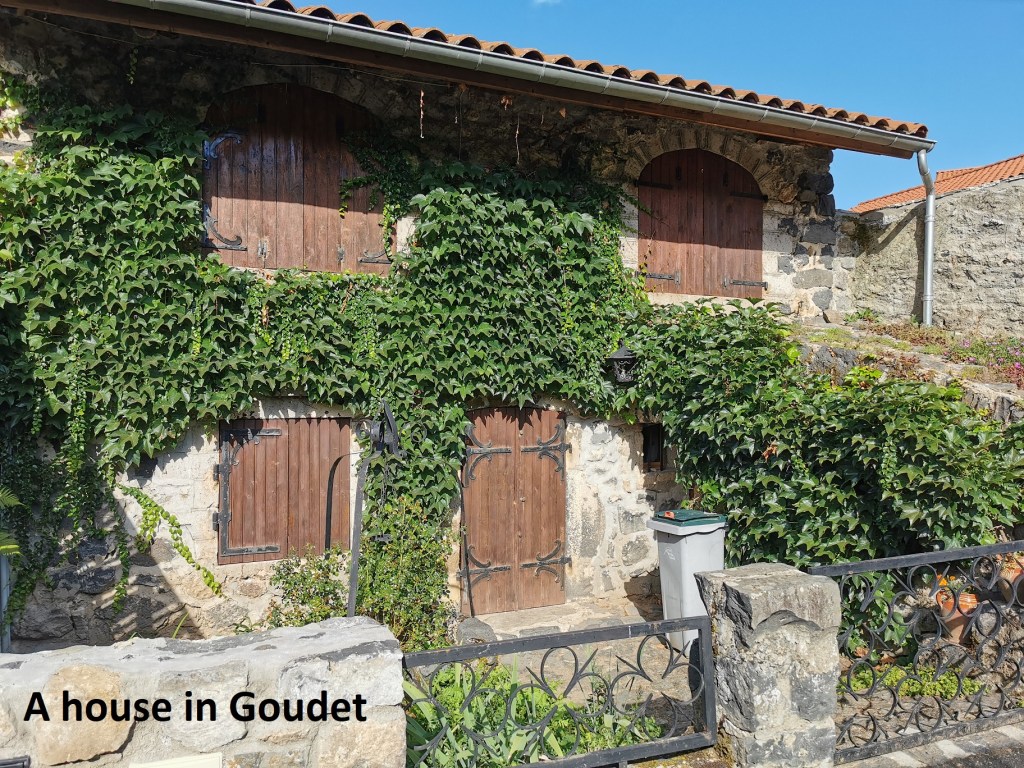
We went on up the hill, and before too long the ground flattened out. We were walking well and making a good pace. The little village of St-Martin-de-Fugeres had nothing to offer us, and we went quickly through it. I expect that Stevenson followed the road to Goudet, but our route over the mountains meant that not long after St-Martin-de-Fugeres, we had a steep descent into the village. Goudet is a quaint place, Stevenson mentions stopping at the inn there, but when we arrived the hotel in the village was closed. As a result, we could not verify if the portrait of Régis Sinac, noted by Stevenson, was still there. Even worse, we could not get a cold beer to refresh ourselves, with the sun now high in the sky. The campsite, which would not have been there in Stevenson’s time was also closed. No refreshment for a thirsty traveller.
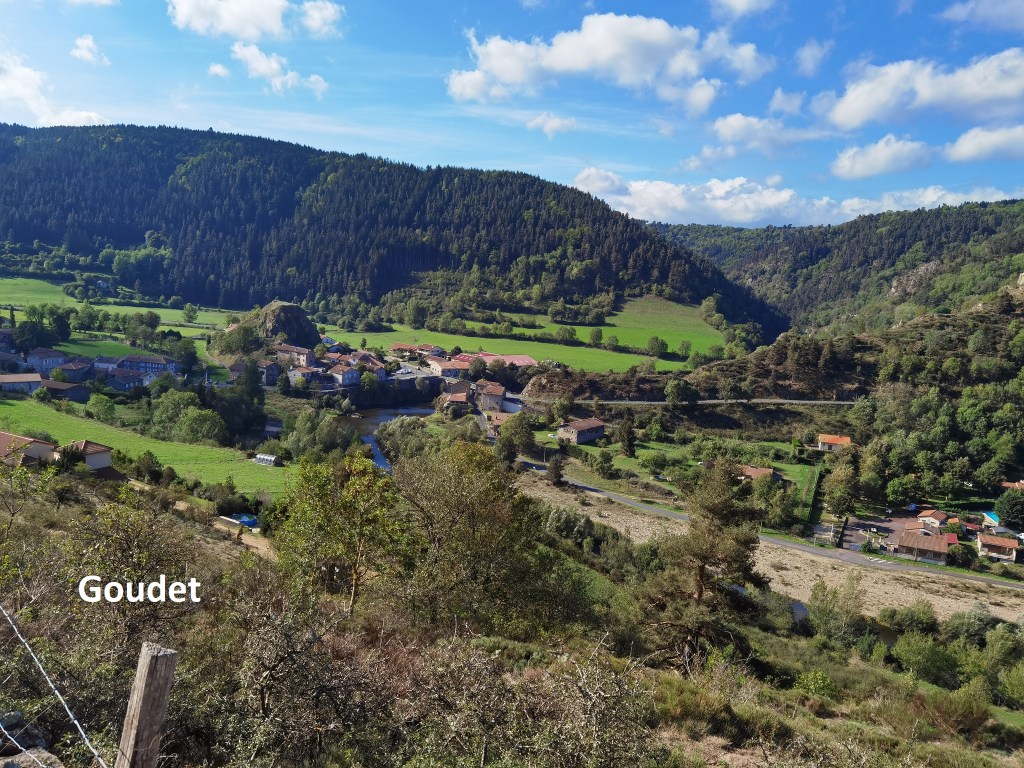
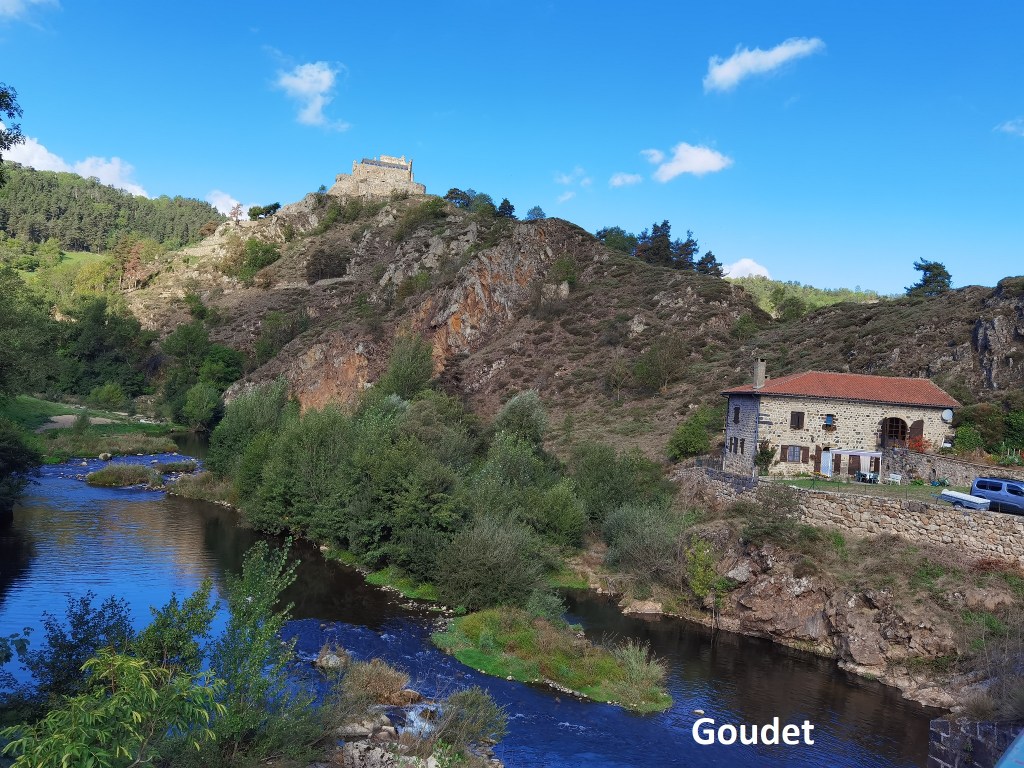
But the Chateau Beaufort still stands just outside the village, and our way wound around the back of that castle. Then it was upwards again, we were eager to get to a village where we might be suitably refreshed. I remembered from the guidebook that there was another village at the top of the rise, but when Joff asked the name, I could not remember it. Montagnards, I suggested? No, they are the mountain people of Vietnam. Armagnac? No, we agreed, that is just wishful thinking. The sign at the edge of the village said Montagnac, so my guesses were close. The guidebook had not indicated anything in Montagnac, and indeed there are no bars or cafes, so we kept on our way. The route then began to descend slightly before rising again as we approached Ulles.
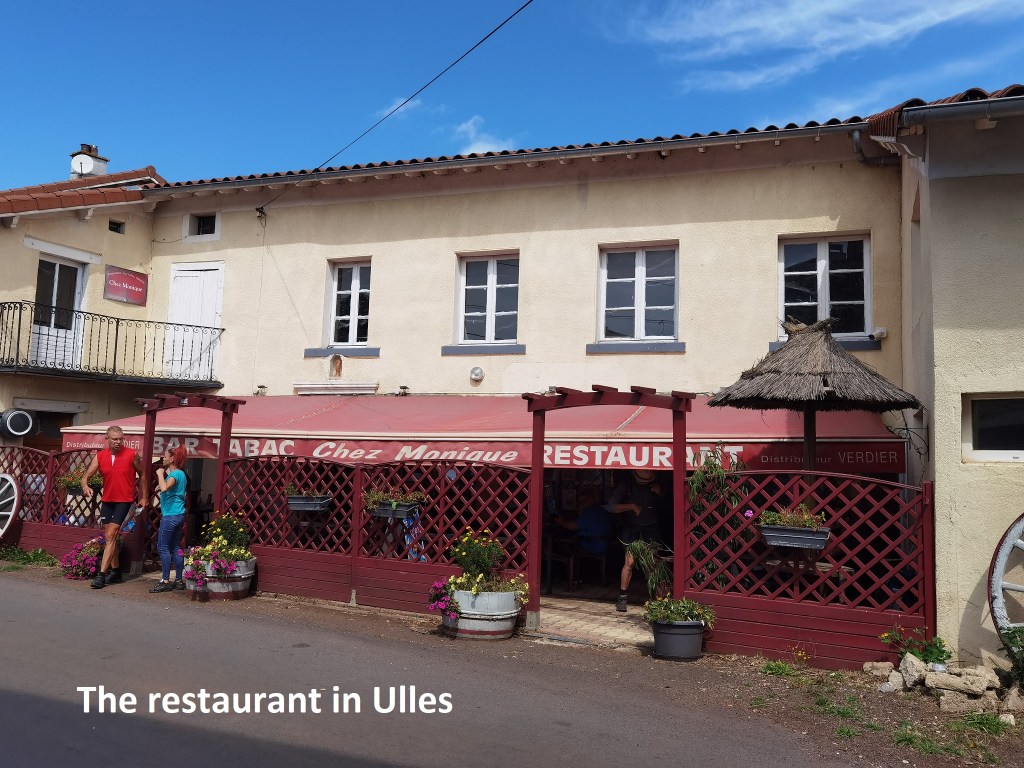
Stevenson records that on entering Ulles with his donkey, Modestine, the pack saddle fell from the donkey. The priest and some men working on the local church found his predicament very funny, and laughed heartily, while others of the village folk stood around offering him useless advice on the design of that pack saddle. As a result, when he got things back on the donkey, he was on his way as soon as he could go. We were hoping for a better reception in Ulles. The guidebook had shown a bar in the village, just a few metres off the route. Coming to the centre of the village, Joff expressed his disappointment that he could see no sign of a restaurant. From a little in front, I admonished him.
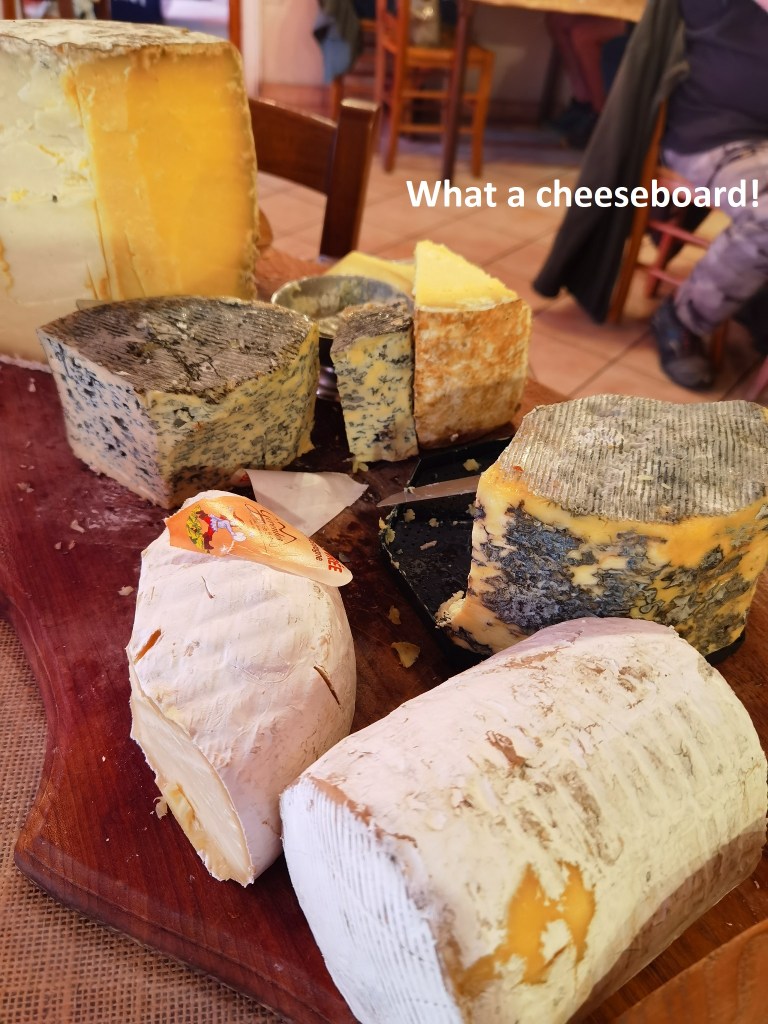
“Oh ye of little faith,” I said as I pointed down a side road. There, just off the route was a restaurant. We dropped our bags at the door, and went in. Most of the clientele seemed local, which is always a good sign. The fixed price menu included the most formidable cheeseboard I have ever seen in any restaurant, or probably ever will see. There were hard cheeses, soft cheeses and blue cheeses in substantial quantity. Washed down with a couple of beers, it was indeed a hearty lunch. It was hard to leave the table, but we still had a way to go, so once our hunger and thirst were satisfied, we were on our way again.
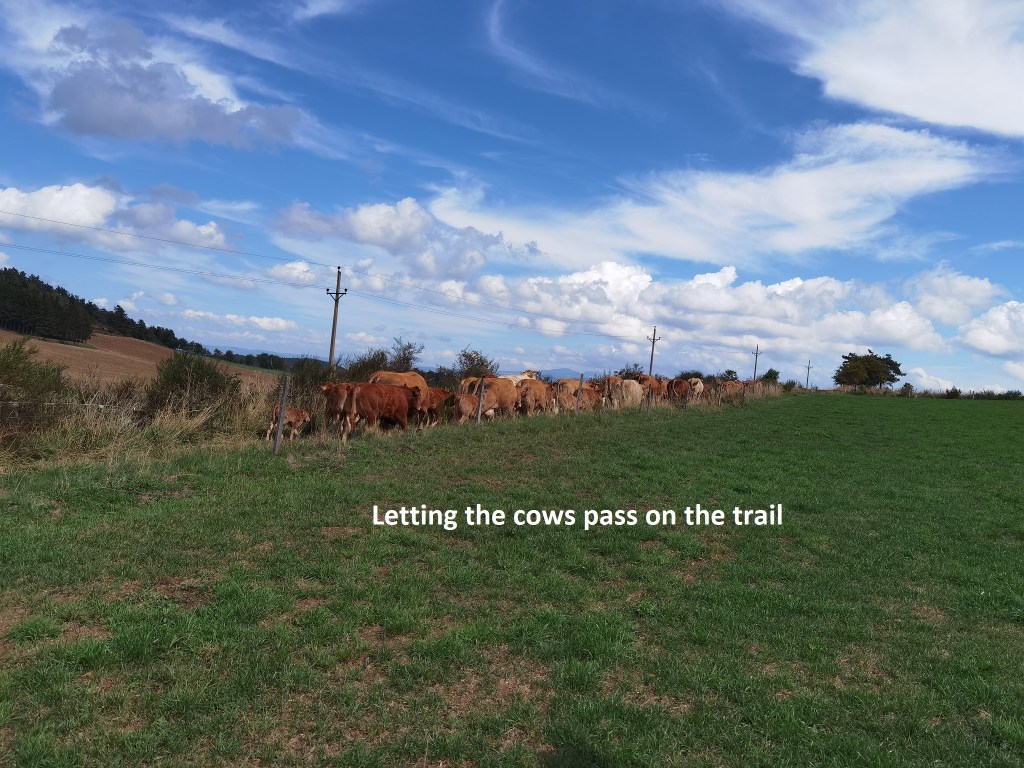
With strength restored after the meal, we soon recovered our stride and were making good time again. Stevenson wrote of ”an infinity of little country roads led hither and thither among the fields”, and as a result, he seems to have lost his way several times. We had no such misfortune. In the 21st century, the way is well signposted, and after the initial post-lunch inertia, we were moving well. At one point we encountered a woman coming towards us, waving at us to move to the side. Behind her, was a herd of cattle, and behind them was a man driving them forward. We stepped into the field to let them pass. We also me a group of three people with two dogs who were walking the route. One of the dogs had an appearance that showed wolf ancestry, while the other seemed like a cross between a collie and an Afghan hound. Both dogs were well behaved as we passed.
We went through Bargette, a village not mentioned by Stevenson. The next site of habitation, Preysac can hardly be called a village; it is really just a farming settlement. Stevenson must have gone a different route, as he does not mention either of these places. We had none of his difficulty in reaching le Bouchet-St-Nicolas and got there in the late afternoon. Stevenson stayed in an inn, but in these modern times, the walker on the route has a choice of gites in the village. We stayed at the gite communal. We were lucky in being among the first to arrive there, so we were able to pick our places in the dormitory and have our showers before it got busy. Then all we had to do was to relax and wait for dinner.
Dinner in a gite is a social affair. There were fifteen people at the table, giving us a chance to get to know some our fellow walkers and chat about the route. Next to us were two young ladies who were following the trail as far as Langogne. The pressures of the world dictated that they had to go back to their places of work after that. The walkers with the two dogs were also present, both dogs sitting quietly while everyone ate. The one with wolf definitely in his ancestors even seemed a little shy, backing away when confronted in corridors or on the stairs. Perhaps the fearsome reputation of those lupine ancestors is not entirely true.
After the dinner, the curator of the gite showed us all where everything was for the breakfast next morning. With that, everyone said goodnight and turned in to get some rest and prepare for the morrow.

 Walkingman
Perfect cheeseboard. Not seen anywhere myself too!
LikeLike