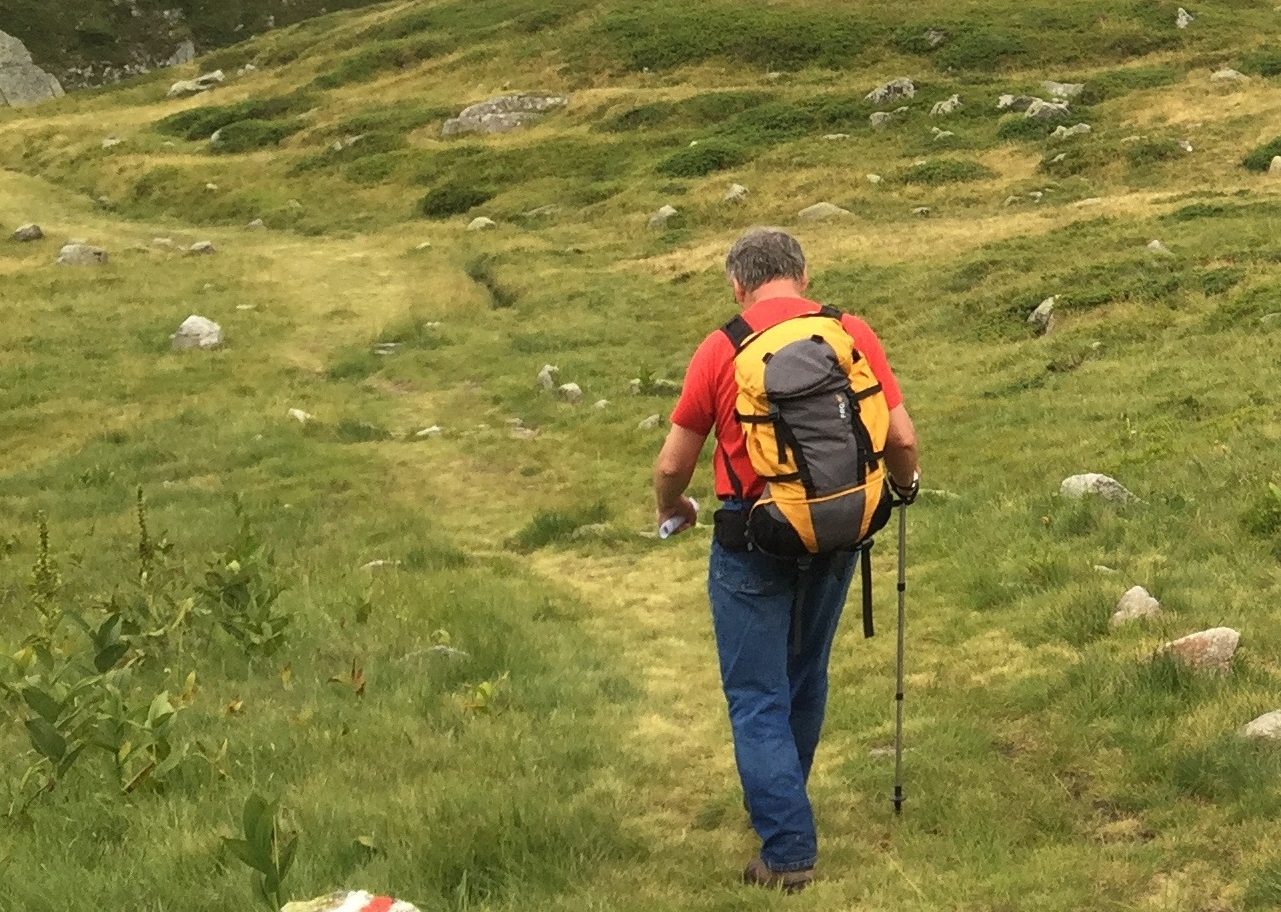
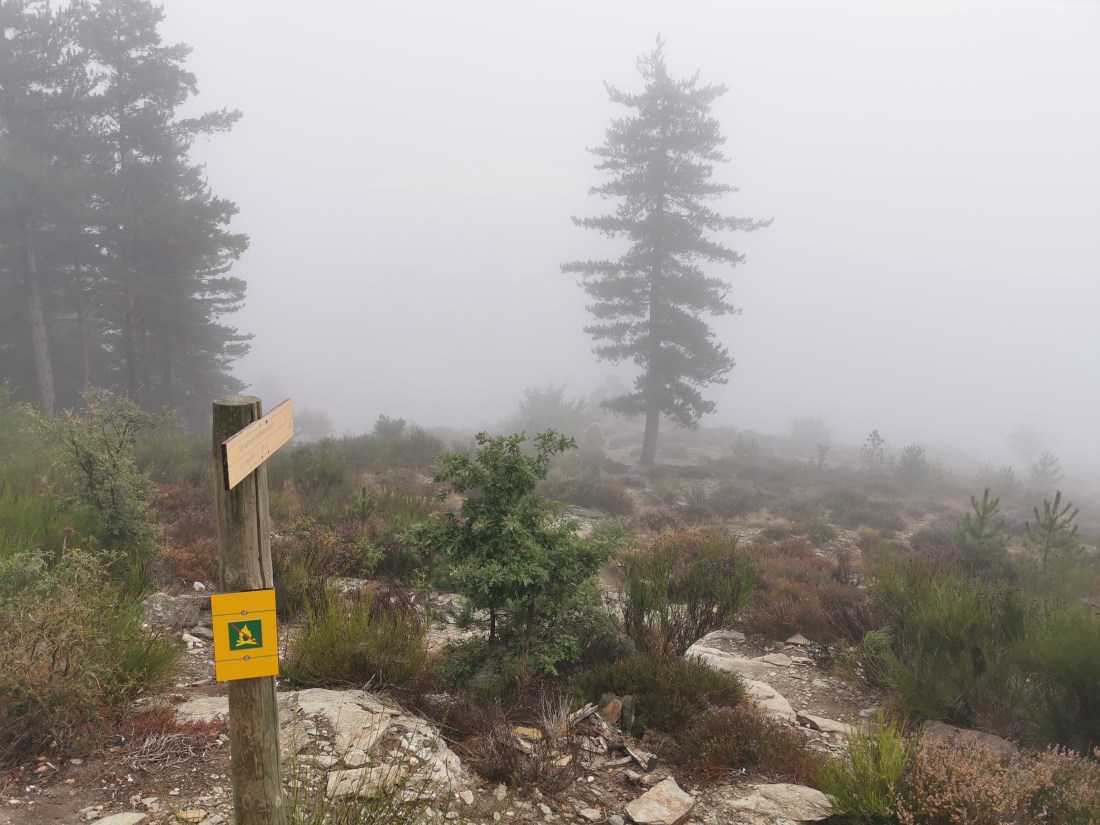
Although it did not provide a very comfortable night, the campsite did have one major advantage that our more luxurious accommodations of the nights before did not: it offered breakfast. And a good breakfast it was, setting us up well for the day. Although the rain had stopped by then, the morning was still misty, with low cloud all around.
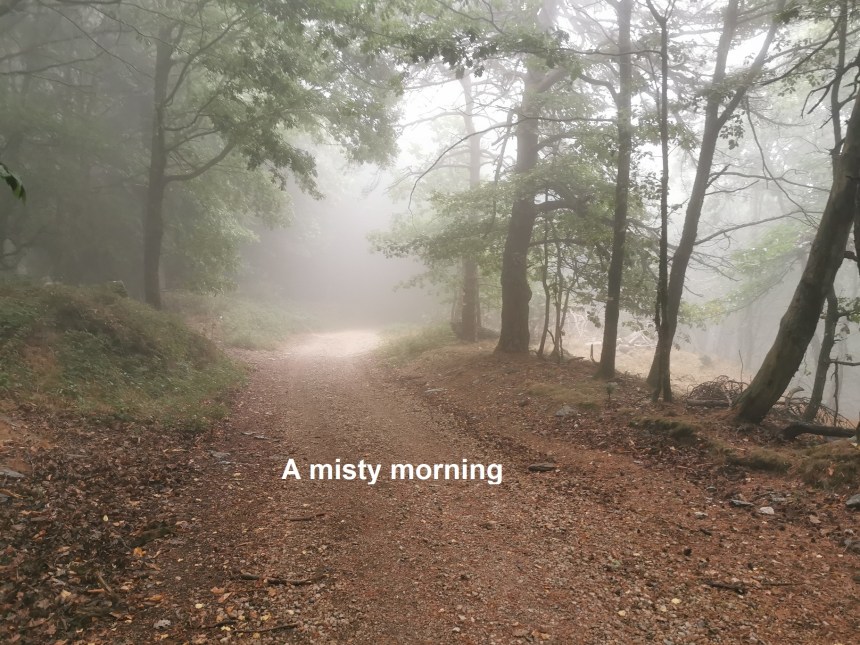
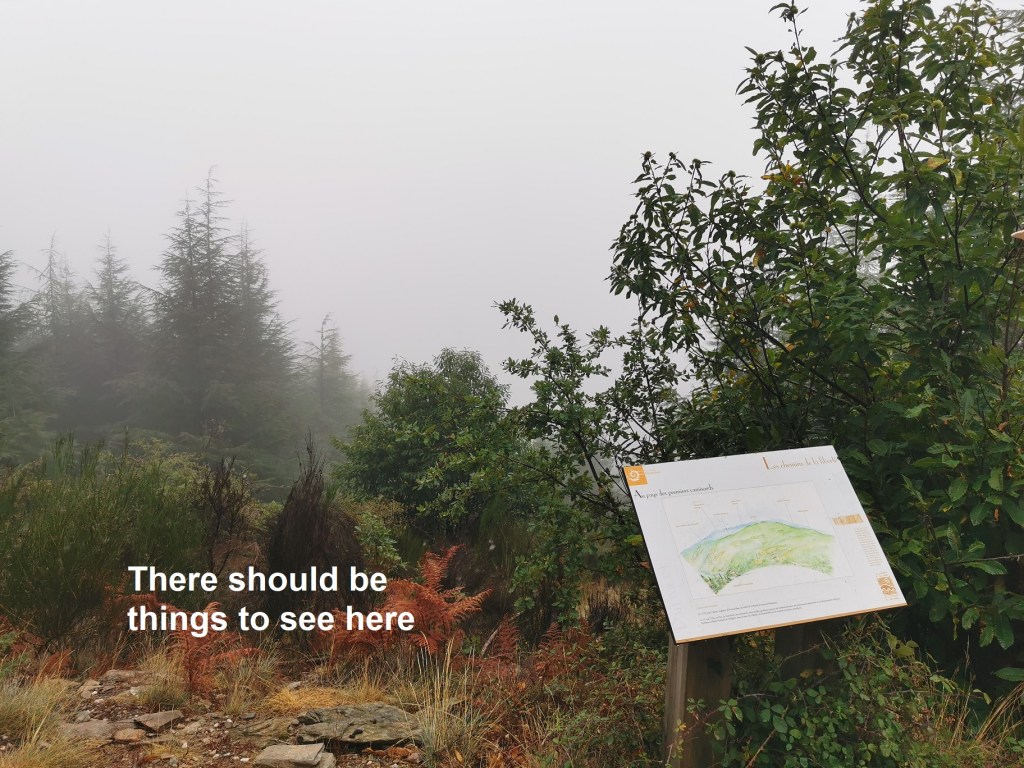
There are two possible routes from the Gare de Cassagnas. One goes south before turning east, while the other goes east before turning south. We chose the former. We crossed the Mimente, and followed a tributary briefly, before crossing that and going into the forest. Once in the forest, the route twisted around, rising gradually, The track was a forest road, wide and easy, but going up and up. It wasn’t long before we were in the mist. But we were not finished on the ascent, and it was a little while longer before we reached the highest point where the route turned east. As we went on, we came to a place where there was supposed to be a magnificent view to the south. There was even a plaque to tell us what we should be looking at. But all we could see was grey.
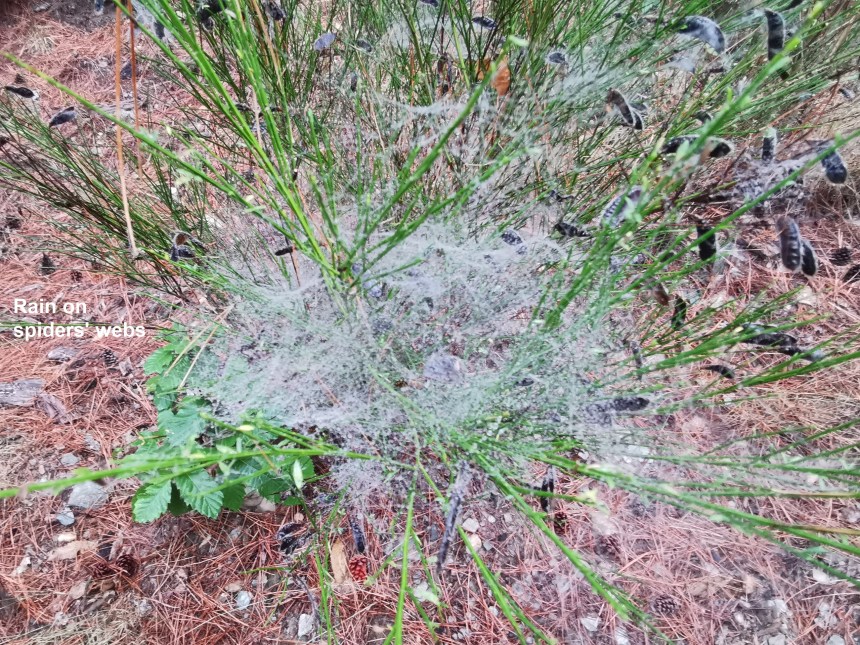
All along the higher part of the route, and even later, the rain and the dew had combined to highlight every spider’s web on the bushes growing near the trail. One type of bush seemed to be particularly favoured by the spiders, and each web was just a mass of glittering droplets of water. Even in the bad weather, the wonders of nature can be appreciated.
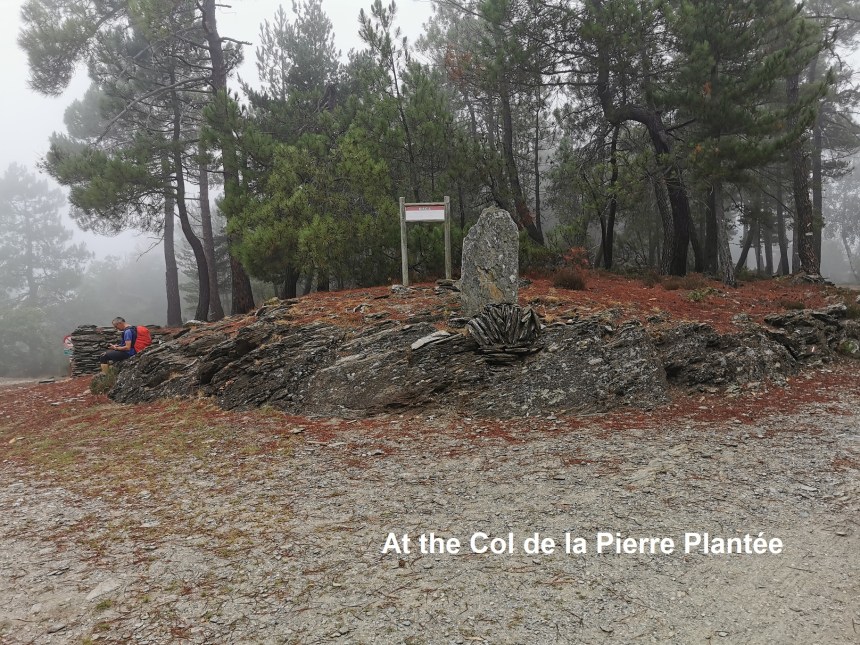
We went on. At one point, we met a truck coming the other way with a cargo of logs. We wondered if the driver, going upwards through the forest, was going the wrong way. But as we went on, and the trail continued to descend, it narrowed as well, so maybe the truck was actually going in the right direction. But it didn’t matter to us, we just kept on going. The route snaked around, but generally going eastwards until we came to the Col de la Pierre Plantée, the Col of the Planted Rock. We rested for a minute or two, and then went on. We continued to descend, eventually reaching the road just outside the village of St-Germain-de-Calberte. Although dry, the day was still cloudy, and we continued on into the village.
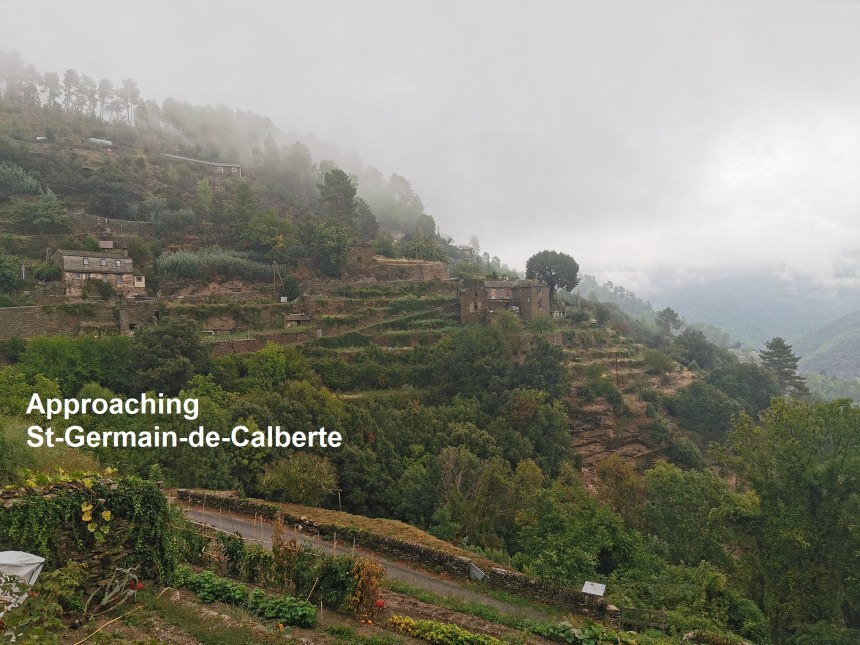
St. Germain occupied a strange place among the local communities. At the time of the Camisard Wars, St. Germain was a Catholic village set against a Protestant hinterland. In the febrile atmosphere of the time, that was bound to cause problems. Also, it was the original home of the Abbot du Chayla. After he was killed in Pont de Montvert in 1702, his body was brought back to St. Germain, and buried there will all honours due to a senior churchman. The Camisards attacked the village months afterwards in January 1703. Although they burnt some houses, they were repulsed. The village remained loyal to Catholicism in spite of the feeling of the communities in the countryside around them.
Stevenson reported that St. Germain was asleep when he arrived in the early morning. It seemed little better when we arrived, with few people in the streets. But there was a bar open, and we were able to get some food. We enjoyed a quiet outdoor lunch before taking a short walk around the village. It didn’t take long to see all there was to be seen, just a few minutes. And then we were on our way again.

From St-Germain-de-Calberte, the route goes back into the woods, but generally runs close to the road towards St-Etienne-Vallée-Francais. And it runs downhill all the way. The road snakes around on its way, and so does the trail. Eventually, the trail comes back onto the toad. We should have seen a sign at that point to lead us to the Pont de Burgen, but we missed it. We followed the road for a few hundred metres, and then took the side road towards the gite. All the time, the weather was threatening. I had texted to the proprietor to let him know our expected time of arrival, and he came to greet us just a few minutes after we arrived The proprietor was an interesting character. He had spent his early years in California before attending a public school in England. Joff and I wondered what would bring a person from such a background to an obscure location in the Cevennes by choice. Joff reckoned he was a writer as well as owning the gite. We never found out.
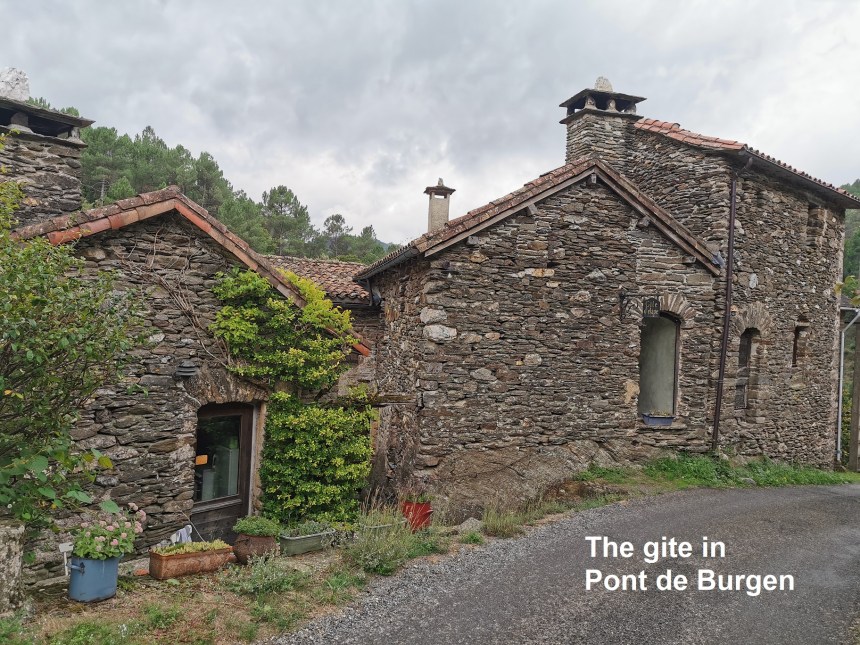
The gite itself was a stone building, clearly of considerable age. Inside, the main room functioned as a dining room. At one end was a huge fireplace, with a massive wooden beam, as long as the room was wide, supporting the chimney. In the midst of this ancient stonework, a print of a painting by Kandinsky hung on one wall. Apart from the kitchen, the rest of the building seemed to be dormitories and bathroom facilities, the basic ones downstairs, and the better ones upstairs. We had a downstairs dormitory, and we were the only people there. Some cases belonging to other walkers were delivered by taxi. Some people get their luggage delivered from place to place and walk with only a very light pack. The walkers involved arrived shortly afterward while the proprietor was gone to get food, and we directed them to their rooms as the proprietor has asked us. Also, while we were washing and resting, a thunderstorm rolled in. For a while, the thunder rolled and the lightning flashed, while the rain poured down. It was not weather to be out, but we were not going anywhere.
Dinner came later, cooked by the wife of the proprietor. It was a hearty meal, starting with soup and a savoury stew to follow. There were second helpings for anyone who wanted them, and we did not refuse. The hostess made sure that everyone had enough. At the meal, there were the three people with the two dogs, the same that we had first met in Le-Bouchet-Saintt-Nicolas. As always, the dogs were well behaved, and did not affect anyone’s enjoyment of the dinner. There were ten of us present altogether. One of the guests remarked that we Irish do not do much long distance hiking. This remark came from one of the people who was having their luggage delivered to each place ahead of them! And this while Joff and I were carrying everything on our backs. I made sure in the conversation to slip in my experience of the Camino de Santiago and that I have hiked extensively in Switzerland. With some of the others I shared my memories of the botanical wonders of the Aubrac and the beauty of Conques We Irish can hike as well as any Frenchman. There are just not as many of us.
The same couple mentioned that they had been to Ireland, where one of them broke an arm in the Gap of Dunloe in Kerry. The Gap of Dunloe is a popular walking route, on a broad track. How one would break and arm there, I just cannot understand.
After that, we all turned in for our night’s rest. There was another thunderstorm during the night. Joff slept soundly through the storm, though I was woken before morning. Truly, not everyone is the same.

 Walkingman