In Florac, just as in Pont de Montvert, the accommodation did not provide breakfast. So once more, we rose early to find a place for a meal that would start us on our way. Our first hope was for the place where we had got the beer the previous afternoon, but alas, that had not opened yet. We tried the place that was closing when I had entered Florac, but that too was closed. It looked like the early bird might not get the worm after all. But the boulangerie was open, and that would definitely meet our needs. When we went in, we found that not only did they sell bread at such an early hour, but they had freshly prepared sandwiches of cheese and ham as well. We bought the sandwiches for later, and a couple of pastries for an immediate glucose rush. The pastries were soon gone, and we went on our way.
At the edge of the town, we came across a hotel. It would be worth asking if we could get breakfast, we thought. And sure enough, for a modest price, we could avail of the buffet breakfast. Among the other guests having breakfast was the group that we had met at Chasseradès. We had not seen them since Les Alpiers. It seemed like they were generally going for more upmarket accommodation than us. That helped to relieve any feelings that we should be roughing it in the same way as some others, who camped every night. Stevenson camped several nights on his journey, and his narrative reports it as a mixed experience.
Also among the hotel guests there at breakfast was a group of motorbike enthusiasts from the Czech Republic. Their Indian machines were parked outside, polished chrome gleaming in the sunshine. Joff is a motorbike enthusiast and spent some time looking over the bikes while I was negotiating the price of breakfast. The Indian Motorcycle was America’s first motorbike company, and the brand has a worldwide following, and I now know that includes the Czech Republic. They passed us later on the road, their bikes making a colourful, if noisy procession.
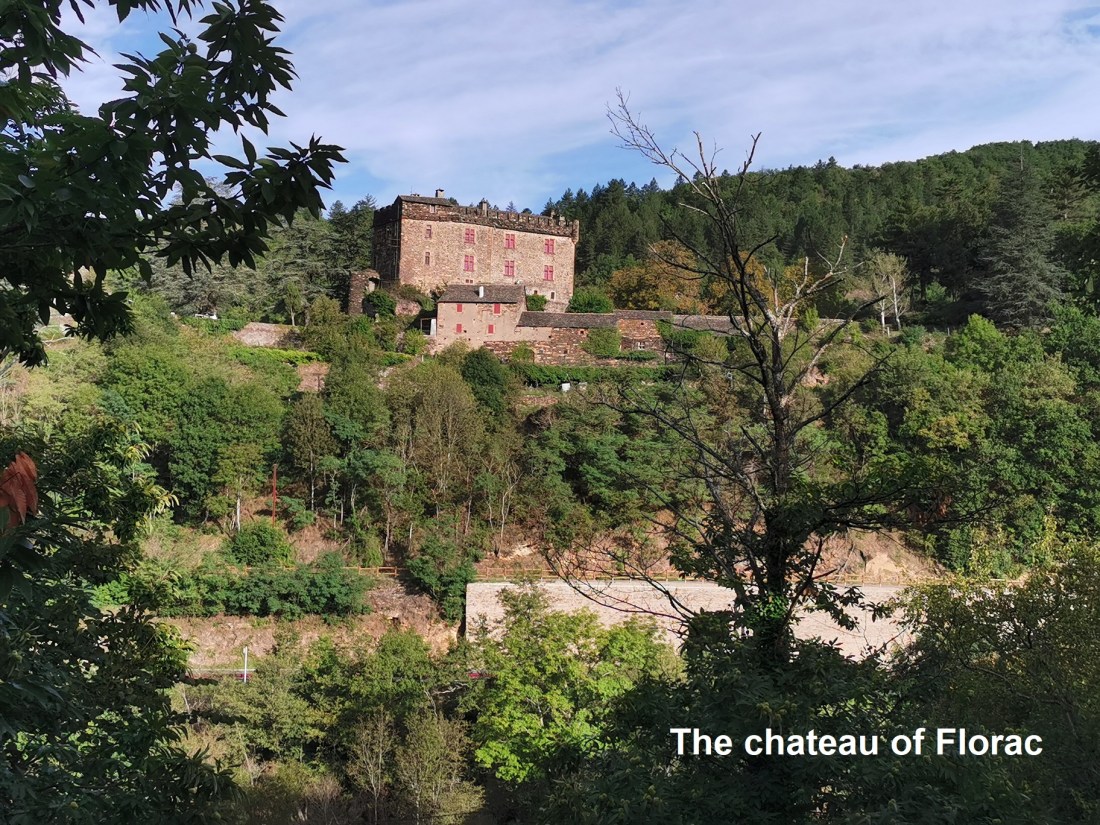
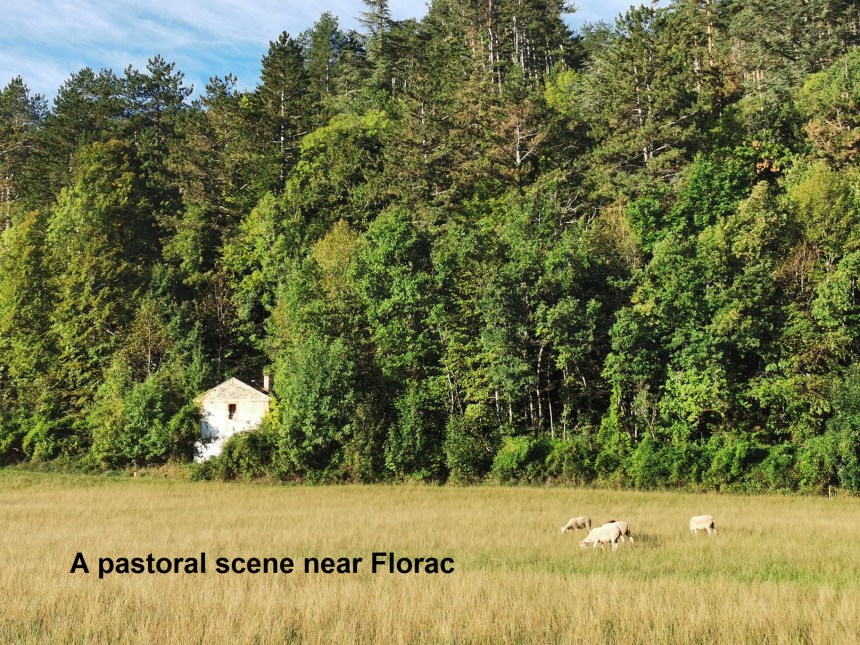
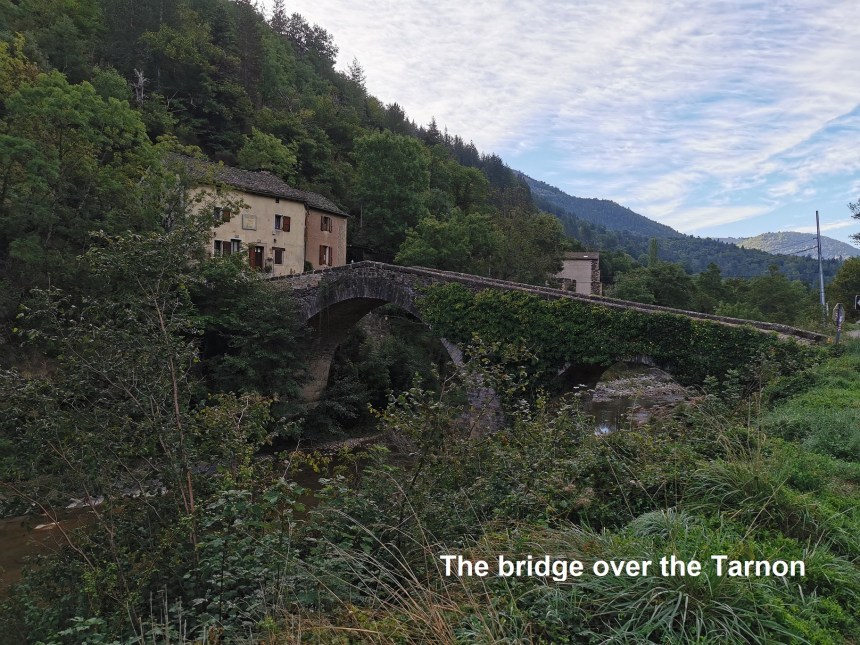
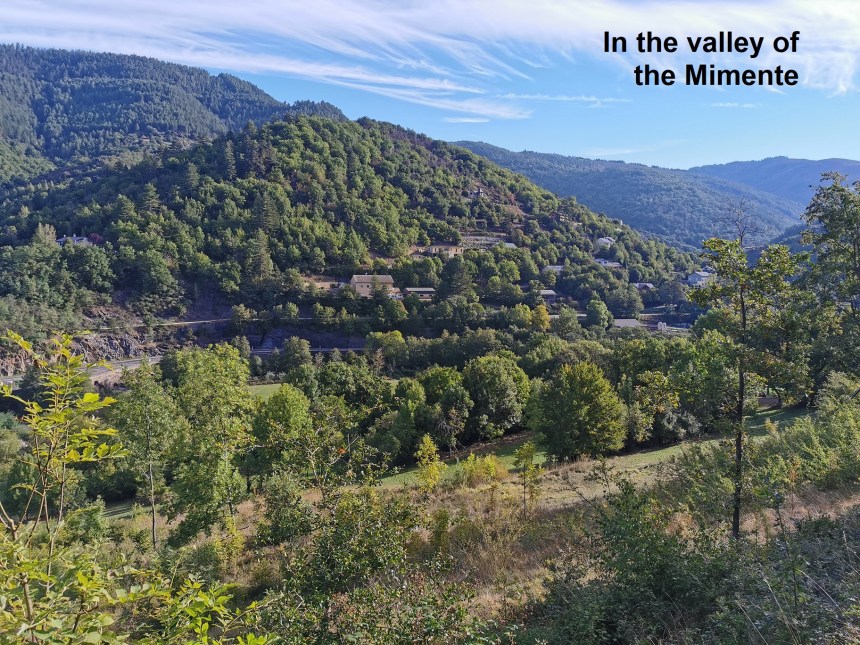
With breakfast done, we set out on our way again. The route initially heads south out of Florac, but then crosses over the Tarnon, and curves around the side of the hill to follow the valley of the Mimente going eastwards. The route ran through woodland, and eventually crossed over the Mimente to reach Saint-Julien-d’Arpaon. There is a campsite there, and the guidebook had indicated that we might find refreshments there. As we approached, Joff expressed some disappointment that it seemed to be closed, but his disappointment was misplaced. We were able to sit under the trees in dappled sunshine and enjoy a beer.
After Saint-Julien-d’Arpaon, the route follows the track bed of an old railway. The proposal for a railway in this area first came in 1879, the year after Stevenson made his journey. The government in Paris wanted to link all departments of France by rail. The proposal was to have a line from Florac to Sainte-Cécile-d’Andorge, which is on the Cevennes line toward Nîmes. But the company running that line, the Compagnie des Chemins de fer de Paris à Lyon et à la Méditerranée (PLM), refused on the grounds that the line would be uneconomical. However, the idea didn’t go away. The proposal was revised from a standard gauge line to metre gauge, which would lower the costs and make the engineering works easier. Nevertheless, it was 1904 before work commenced on construction of the line. It was opened for traffic in 1909. It took two hours and thirty minutes to go the length of the line, just 49km. No doubt, that seemed very reasonable in 1909, but as road traffic progressed, it was clearly unsustainable. The line closed in 1968. The track bed remains now as a walking route, while some of the rolling stock is in museums and on tourist railways.
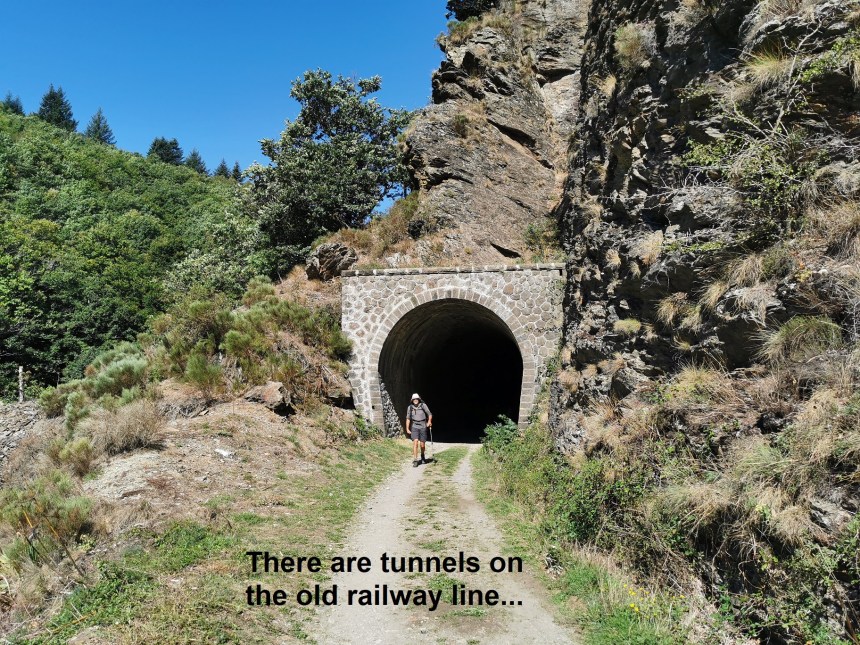
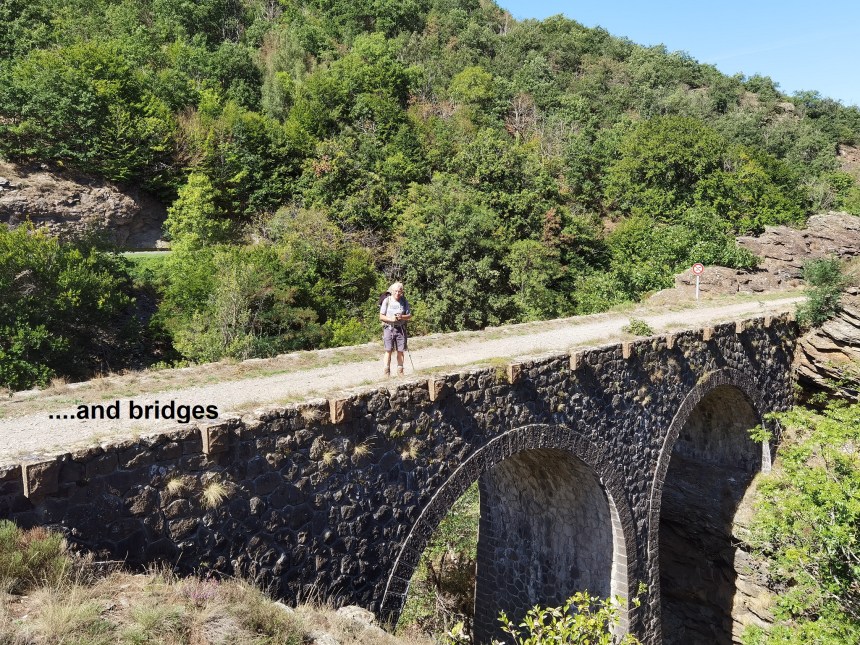
One thing about walking a route that has been a railway line is that it is relatively flat, which made the going easy for Joff and myself. The line goes through three tunnels on the way to Cassagnas, none of them long enough for the walker to need a torch. It also crosses over a substantial bridge, and numerous culverts along the way. It crosses the main road from Florac to Cassagnas, but the road was quiet with no traffic when we came there. And so we came eventually to the Gare de Cassagnas. Like Chasseradès and so many other places, the village station is not in the village itself, but a short distance outside. And as in other places, a community grew up around the old station. This was where we had planned to spend the night.
When I had been booking accommodation, the most problematic location was this Gare de Cassagnas. I tried all the gites, and all the chambres d’hote, which is the French system of B&B, but without success. I could find nothing close by. In my discussions with Joff before the trip, we were reconciled to camping out one night, and this would be it. Here we were now at the campsite, so the moment of truth had finally arrived. We went to reception and paid our fee. The receptionist asked us the usual question of where we were from. On my answering that Joff was English living in Ireland, while I am Irish living in Switzerland, she remarked that I speak English like a German. I have not yet made up my mind whether that is good or bad, to be cherished or to be regretted. We next went to pick out a place in the campsite. Initially, it was just a case of throwing down our rucksacks to mark that the space was taken, and then we could go to get a beer and eat the sandwiches we had bought in Florac. With beer drunk and sandwiches eaten, the next thing was to have a shower, and clean up. Then it was time to get out the camping gear for our overnight rest.
We were not using tents. Each of us was using bivouac equipment, which provides almost the most basic shelter imaginable. It is basically a bag, that the sleeping bag fits inside, and the outer bag protects the person inside from the elements. It is quickly set up, but does not offer the comfort of a tent, such as that is. So we soon had everything ready. Just as I was finishing my preparations, Jim walked past on the trail. He was going on to St-Germain-de-Calberte, another eight kilometres farther on. We wished him well and watched him continue along the trail. We did not see him again on our travels.
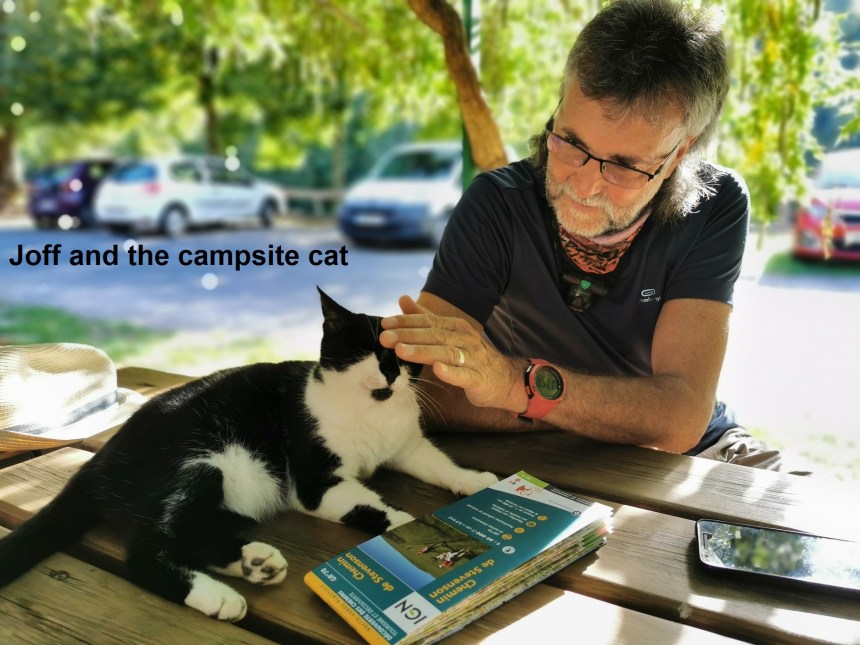
I also had another task to do. I thought I had booked accommodation in the next day’s destination, St-Etienne-Vallée-Francais, but when I checked my paperwork, it had not been confirmed. So I spent a little while making phone calls to the various gites in St-Etienne. All were either fully booked or didn’t answer the phone. I looked at what was available in the surrounding communities, and I managed to get a place in a gite at Pont de Burgen, just a little outside St-Etienne. I did not know it at the time, but that was to be one of the more memorable gites along the way. Then we could rest at the campsite’s picnic tables. While there, the campsite cat took a shine to us, as cats often will. I suspect that for the cat, titbits from campers supplement a diet from hunting.
In the early evening, the campsite served a dinner, and it was truly excellent, both in quantity and quality. Many of our acquaintances from different stages of the route were there, all sharing a good meal. It is hard to beat good food eaten in good company.
After dinner, we turned in for the night. I slept fitfully on the hard ground. Camping on soft ground is one thing, but at the end of the season, the ground at this campsite had been hardened over the summer by walkers, vehicles, and so on. I awoke at about one o’clock in the morning and on looking up, it seemed that every star in the sky was visible. I awoke again at about half past three, and clouds had obscured the stars. I awoke again shortly after five o’clock and a mist had come down. At six o’clock, a light rain was falling, and I decided that it was time to get up. In the shelter of the shower block, I washed and dressed, and soon the daylight came.

 Walkingman