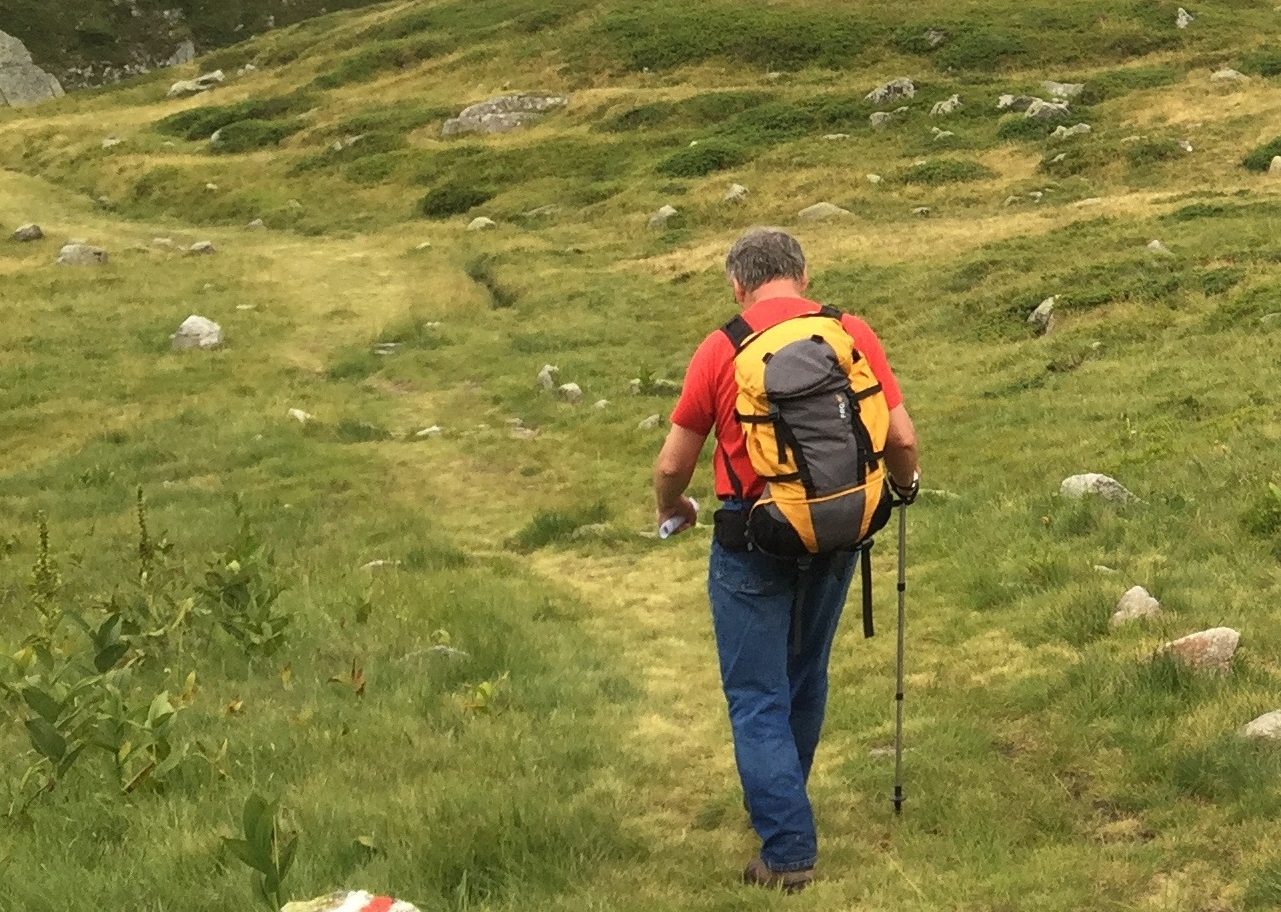
Like so many things in this life, the decision was made over a pint of beer.
But first, let’s go back a little while. In 2019, business brought me to the little town of Alès in Provence. While I was there, one of the people I was meeting mentioned that Alès was at the southern end of the Chemin de Stevenson. And that brought back memories. In my youth, my mother often referred to the pairings of literary characters with their animals. Sancho Panza’s Dapple got an honourable mention, but Robert Louis Stevenson’s Modestine was higher on her list favourites.
Somewhere in the years since then, I had read “Travels in the Cevennes with a Donkey”, but the places talked about meant nothing to me at the time, and I completely forgot about it, until that business meeting in Alès. There was also a visit to a bookshop in Basel where I found, by chance, a guide to the Chemin de Stevenson. I snapped it up immediately. I also went back and read Stevenson’s account of his journey with Modestine. And I put the route on my list of things that I might do sometime, but without any definite plans. After all, I had a bigger project to work on. Through the course of several vacations, I was making my way across France and Spain, from Geneva to Santiago.
But my journey on the Camino came to an end in 2021. I needed a new project. The Chemin de Stevenson was back in focus, but there were other possibilities as well. Then, in December 2021, I was on Lugnaquila with my sister Moira and her partner Joff. In the bar of Fenton’s pub at the end of the walk, we discussed what major walk I might do next. I mentioned some possibilities, including the Chemin de Stevenson. As we discussed the possibilities, Joff said to me: “If you decide to do the Chemin de Stevenson, I would want to do it with you”.
That settled it, and my major walk for 2022 had to be the Chemin de Stevenson. We talked about guidebooks. I had the French Topo guide, so he got the Cicerone guide. We talked about when to go. I outlined my preference for September, still warm, but after the oppressive heat of August. By February, we had fixed the date and Joff had booked his flights.
Things went quiet then, but in June, I decided to start working seriously on the arrangements. Where Joff would travel from Dublin to Lyon by air, I would go by rail from Basel. I booked the train tickets for the link-up with Joff in Lyon. I worked on the onward train journey for both of us to Le-Puy-en-Velay. And I started booking accommodation. As more and more things were confirmed, it was clear that there was no going back now. The adventure was definitely on.
I met with Joff at the end of June and we discussed the arrangements. We talked about what he would bring and what I would bring. We discussed the possible weather in the Auvergne and Provence in September. We discussed the nature of gite accommodation in France. With the weeks going by, and the walk getting close, enthusiasm was growing as we talked.
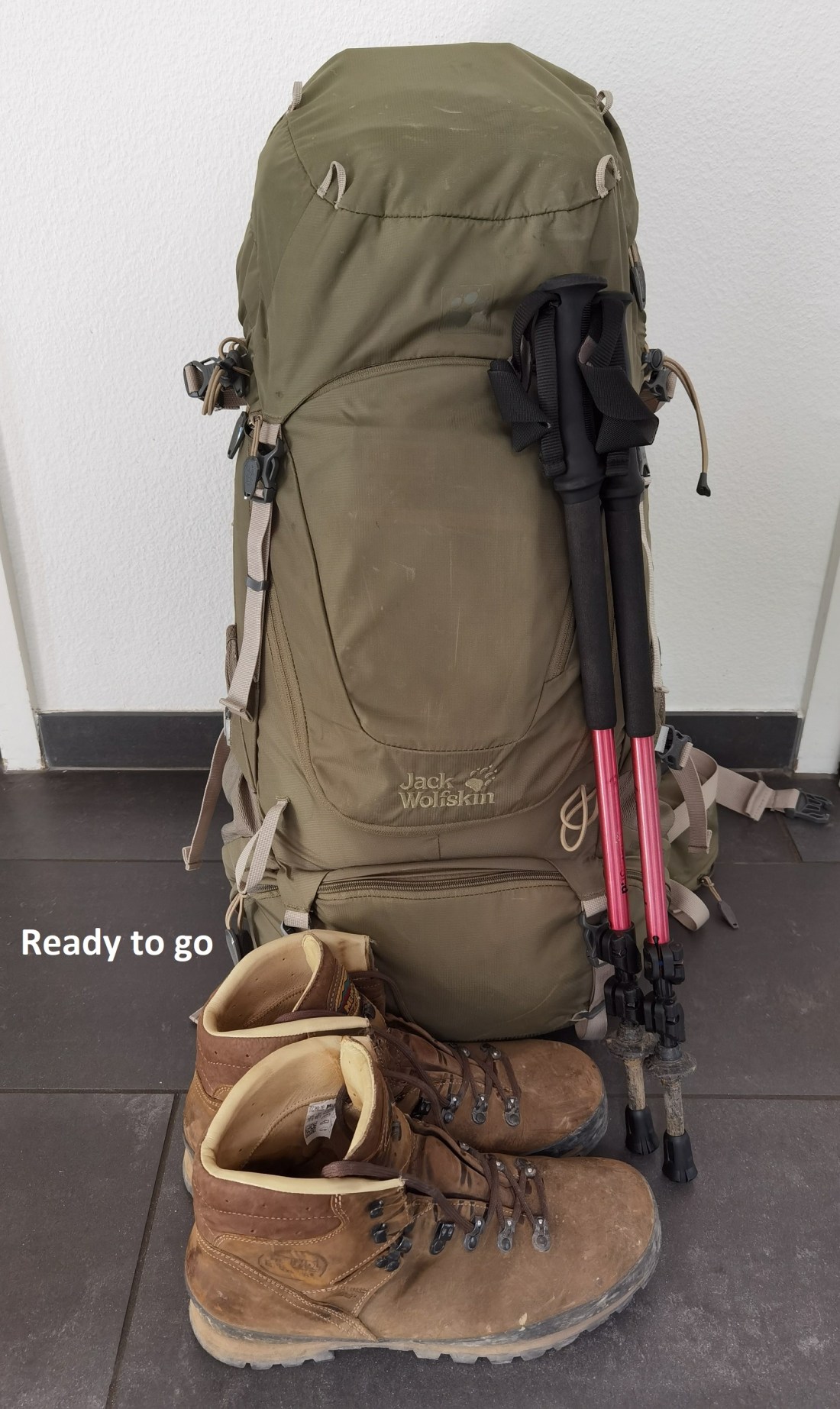
Both of us were ready to go.
**********
Robert Louis Stevenson is best known for his adventure stories. Treasure Island, Dr Jekyll and Mr. Hyde and Kidnapped are the best known. His descriptions of Long John Silver, and the subsequent cinematic depictions of that character have set the standards for portrayal of pirates ever since. Stevenson is less well known for his travel writing, though he was in many ways the originator of modern travel writing. Previous explorers and adventurers had described their travels, outlining what they did and what they saw. But Stevenson captured the mood of each moment: how he felt, the attitudes of the people he interacted with, and how those people affected him.
Among his travel writing, Stevenson’s account of his journey through central France is probably the best known. He wrote it into a small book entitled “Travels in the Cevennes with a Donkey”. He undertook the journey in late September 1878. He started in the village of Monastier, where he purchased a donkey that he christened Modestine. From there, he walked south as far as the town of St. Jean du Gard. Such was the popularity of the book, then and since, that the French have created a long distance walking route, or Grand Randonée, in recognition of his travels. Stevenson does not say in the book how he got to Monastier. The nearest city is Le-Puy-en-Velay, and so the modern walking route starts there. Although Le-Puy is not mentioned in the book other than a passing reference to its proximity, it is probable that Stevenson went through the city on his way to Monastier. Equally, at the southern end, Stevenson does not say how he got home from St Jean du Gard. It is a small town, and the nearest city is Alès, so that is the official end of the route. In between, the route visits the towns and villages mentioned in the book. Stevenson refers to the city as Alais, though again only a passing reference, mentioning towards the end of his book that he was in a hurry to get there. Stevenson, with his donkey, would have followed the roads of the time, basic as they were in the nineteenth century. The roads followed river valleys as the direct way between towns. Those roads carry traffic of cars and trucks today and are dangerous to the walker. The walking route therefore follows trails across hills and valleys, sometimes shorter than the road and sometimes longer, but always coming back to the villages and towns. It is a reasonable compromise.
One of the early items of discussion between Joff and myself was whether we should have a donkey. Joff maintained that in the interests of historical and literary accuracy, we should have a donkey on the walk. I was adamant that there would be no donkey. Stevenson portrays his donkey, whom he called Modestine, as being an obstinate and stubborn animal. To overcome this, he used a stick and a goad in ways that we would be regarded as unacceptably cruel today. I was unwilling to risk the frustration and problems created by an animal such as Stevenson’s Modestine, and I would not want to have to resort to his methods of motivating her onwards. Indeed, a brochure which we came across while walking the trail gives the following advice: “If you are travelling with a donkey, your furry friend will ‘try’ you, even though it will be better trained than Modestine.” In the end, Joff agreed, and so we would carry everything on our backs, with no beast of burden to help.
**********
With the preparations made, Joff and I met up in Lyon. I arrived there first, travelling by train from Basel. I used the time while waiting for Joff to buy the tickets for the onward rail travel, first to St. Etienne, and the following day to Le-Puy-en-Velay. With that done, I sat down to relax and wait for Joff. While I was waiting, a violent thunderstorm rolled in. drenching all of Lyon, and even causing some water to run into the station hall. It did not seem a good omen for our venture, but the die was cast and we were definitely going to give it our best.
Then, just before Joff was due to arrive, the storm passed, and the rain stopped. Joff had flown in from Ireland, and the tram delivered him dry from the airport to the city train station. After greetings, we went directly to await the train to St. Etienne. The train brought us to the centre of St.Etienne, leaving a short walk to a small hotel for our accommodation. Over a burger and beer, we discussed the plans and prospects for the coming walk. The evening weather seemed set fair, leaving the storm in Lyon only as a memory. The daily distances were set, and most of the accommodation was booked. There were a few gaps, and we were both reconciled that we might be camping at least once. With spirits high, we were ready to face the morrow.

 Walkingman