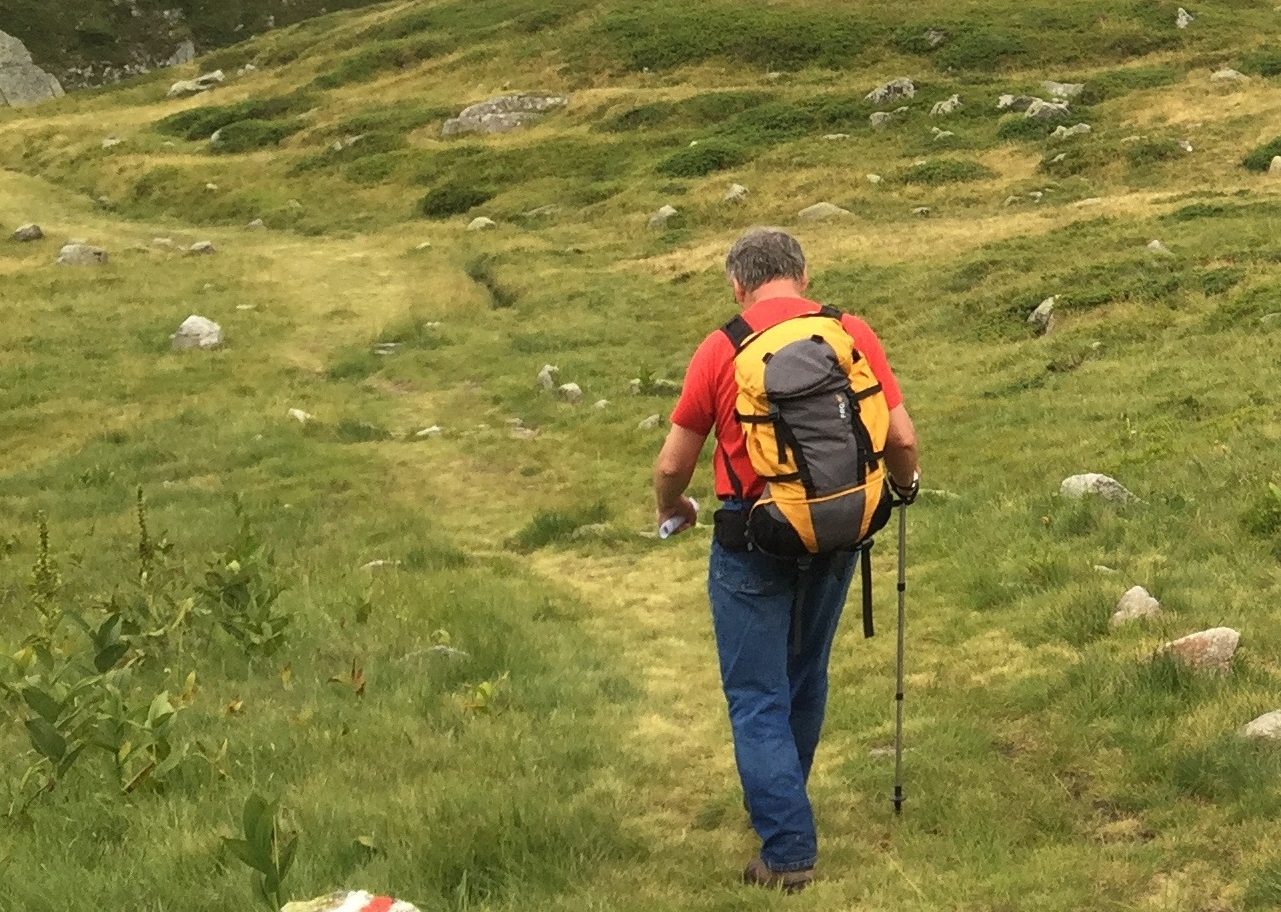

I was in Ireland for Christmas, and on Christmas Eve, when calling to my sister, she mentioned that she and a few friends were planning to go up Lugnaquilla mountain the day after Christmas. She asked if I would be interested to go along.
Now, I must say a couple of things about nomenclature here. In many countries, the 26th of December is referred to as Boxing Day. That name has nothing to do with the sport of boxing, but it was traditionally the day that the boxes of charitable donations in each parish would be opened and the money given to the poor. In Ireland however, the 26th of December is referred to as Saint Stephen’s Day. Saint Stephen is reputed to be the first Christian martyr, stoned to death by the man who would later become Saint Paul, but that is a long story. In any case, we shall refer to the day as Saint Stephen’s Day.
And now a little about Lugnaquilla. Like so many place names in Ireland, the name comes from the Gaelic: Log na Coille. It means the Place of the Forest. There are forests in the area, but alas they are not the original forests that gave the mountain its name. These days the forests are of lodgepole pine and Sitka spruce, not the oak, ash and chestnut that flourished here in centuries past. The mountain itself is 925 metres high, the highest of the Wicklow Hills.
Alas, when my sister issued the invitation, I was dubious. I had no boots. But on Christmas Day, I was lucky enough to be gifted a pair of boots, and so I was ready for the short hike. Six of us made our way to Fenton’s Pub in the Glen of Imaal, that landmark location known to and loved by walkers and climbers for many years. The weather was what might be described as “damp”, that curious Irish phenomenon whereby water just seems to condense out of the air to settle on clothes, hair, and any other exposed parts of the body. But the day boded better and we set off full of optimism. After a short distance along the track, the route goes into the fields and starts to ascend rapidly.
The Glen of Imaal is the location of the main artillery range for the Irish army. The route up Lugnaquilla skirts the edge of the army lands. The boundary is marked by a meering, and it is easy to follow. Even when we reached the cloud level, the meering and the tracks of countless walkers showed the way. The route seemed to go on and on forever, always upwards, but the steepness lessened, and eventually, after almost two hours we reached the top. At one point it looked like the sun might just succeed in breaking through the clouds, but it was not to be: they closed in, and when we got there, the top was completely in cloud.
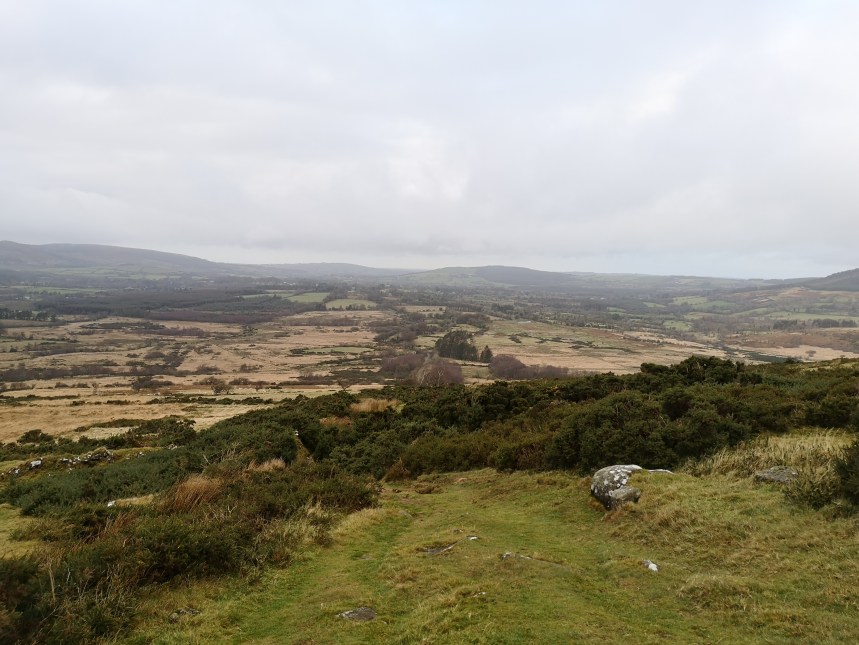
As the rest of the group arrived, we had some refreshments and took photos. The weather at the top was more arctic than Irish, so we did not hang around, but soon started back down. As we descended, we met more walkers coming up the mountain, proof that it is not totally abnormal to spend Saint Stephen’s Day in the outdoors. And there came the time when we were at last below the cloud again, with the farmland spread out below.
When we came at last to Fenton’s, it was time for a warm drink in that establishment. I first came to Fenton’s in the winter of 1976-77, and it has not changed a lot in the years since then. Yes, the bar has been replaced, but in the same place. A few of the pictures and posters have been moved around, and some of the furniture is relatively new. But the feel of the place is timeless, and it is really little different from 40 years ago.
We had our warm drinks, and by early afternoon we were on our way. There can be few better ways to work off the excesses of Christmas eating than a walk in the hills. The fresh air and steep ascent keep muscles active and in trim. And of course, there is the satisfaction of doing something energetic while most people are still at rest.
Finally, my step count for the day: a modest 22,989

 Walkingman