In the early years of the 5th century BC, the expanding Persian Empire was threatening the Greek mainland. The Persians had already captured most of the islands in the Ionian Sea, and had their sights set on Athens. The Athenians knew this, and had a pretty good idea of when and where the Persians would land to attack.
The Greek historian Herodotus recorded that the Athenians sent a messenger to Sparta asking for help. The messenger was Pheidippides, and it was recorded that he ran the route to Sparta in two days, a distance of about 240km. However, the Spartans refused help, reportedly on grounds of religious practice, and Pheidippides had to return to Athens with the news that no help was coming. Reportedly, he again made the 240km journey in two days. However, his work as a messenger did not end there, and he ran again to join the Athenian army at Marathon, a distance of about 40km. At Marathon, the Athenian army of about 10,000 men defeated the very much larger invading Persian force. Pheidippides was given one more task: to run the 40km back to Athens with the news of the victory. He reached the city and went to the council chamber. He gave the news with the words “Joy, we win”, and collapsed and died.
In the late 19th century, when Baron de Coubertin was reviving the Olympic Games, such a story of personal heroism could not be overlooked, and the marathon became an Olympic event. The distance was considered “about 25 or 26 miles” but was not fixed until 1908. In the Olympics of that year, held in London, the marathon started in the grounds of the royal residence at Windsor Castle and ended with a lap of the track in the stadium at White City to finish in front of the royal box, giving a total distance of 26 miles 385 yards. This became the official marathon length. In today’s current metric standards, it is 42.195km.
In the second half of the 20th century, the marathon has moved beyond being an event for elite athletes. Many cities around the world have encouraged athletics with mass participation marathons. Some, such as the Boston Marathon, are famous, but there are many others who quietly organize an event that attracts thousands of people every time.
It has long been an ambition of mine to take part in a marathon. Since I regularly walk more than 30km in my hikes in Switzerland, it did not seem unreasonable that I could do so. In fact, in my recent walks in the Chemin de St. Jacques, I had one day when I walked 38km and another when I walked 37km, so I was confident of my ability to walk 42km, especially without a large backpack and with appropriate athletic shoes.
I say walk, because I simply do not run. The problem with that is that not every city marathon allows walkers. For us, the route has to be kept open longer, and we are still a minority among the participants. But in my home city of Cork, they do allow walkers, and for that reason I chose Cork for my first marathon.
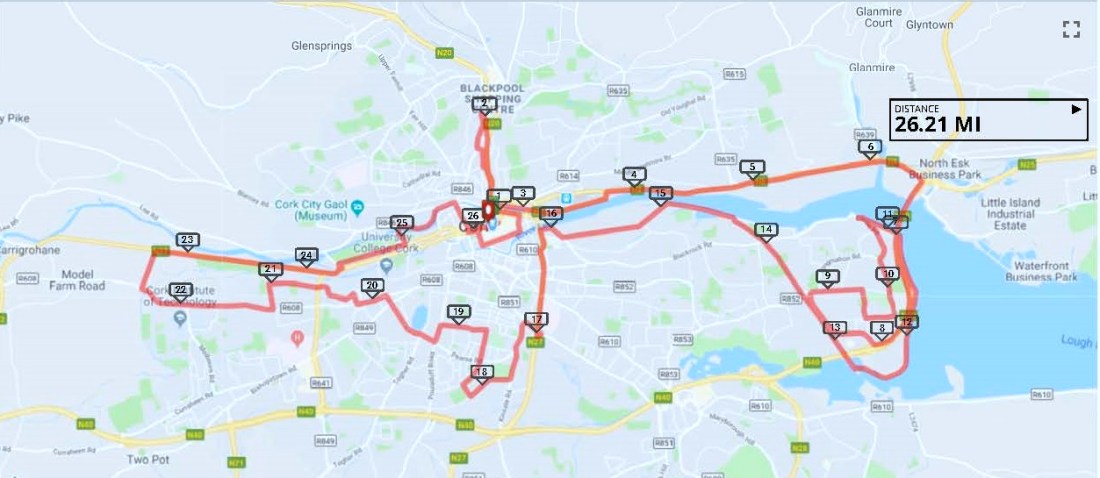
The event was on Sunday June 2nd, and started at 08:30. For some reason, the organisers still measure the distance in miles. There is a marker post at each mile, so I will refer to miles and give the metric distance as well.
The route heads north from the city centre of Cork to reach the Blackpool district at just two miles (3.221km) and I was through there just before 9:00. The route then goes back into the city and out eastwards along the estuary of the River Lee.
The clock is the enemy of all marathon participants, whether walking or running. That is why this posting does not have the usual amount of photographs. On a hike, I can stop to take a photograph, check the map, or simply admire the view, but in a marathon, one has to keep moving. In the Cork City Marathon, shortly after the 6 mile point (9.662km) the route turns south to go under the river through a tunnel, emerging close to the 7 mile marker (11.272km). For traffic control reasons, participants were required to be through this tunnel by 10:30. I was there at 10:10, so things were still in control.
The route loops around the Mahon district before heading back into the city again along a path that was once a railway line. I passed the halfway point (21.098km) on this stretch just after 11:30. The next time requirement was to be through one of the city’s major roads close to the 17 mile (23.375km) mark by 12:30. Unfortunately, due to signage confusion, I took a wrong turn, going 150m off the route, before turning back onto the correct direction, with the result that I just made that time requirement with five minutes to spare.
The route then goes through the western part of the city, passing the soccer and rugby stadiums, close to the city hall, and out to the more rural areas of Cork city. The pace was slightly slower here. Where I was doing 15 minute miles or better at the start, it was now taking 16 minutes for each mile. But with the knowledge that the finish would close at 15:30, I could not afford to slacken very much. At 13:30, I still had six miles (9.662km) to go. At 14:18, that was down to three miles (4.831km), and I was back in the city proper.
By now, my feet were hurting, and muscles were tired, but will and determination was carrying me forward. I never forget the lines from Rudyard Kipling:
If you can force your heart and nerve and sinew
to serve their turn long after they are gone,
and so hold on when there is nothing in you,
except the will which says to them “Hold on.”
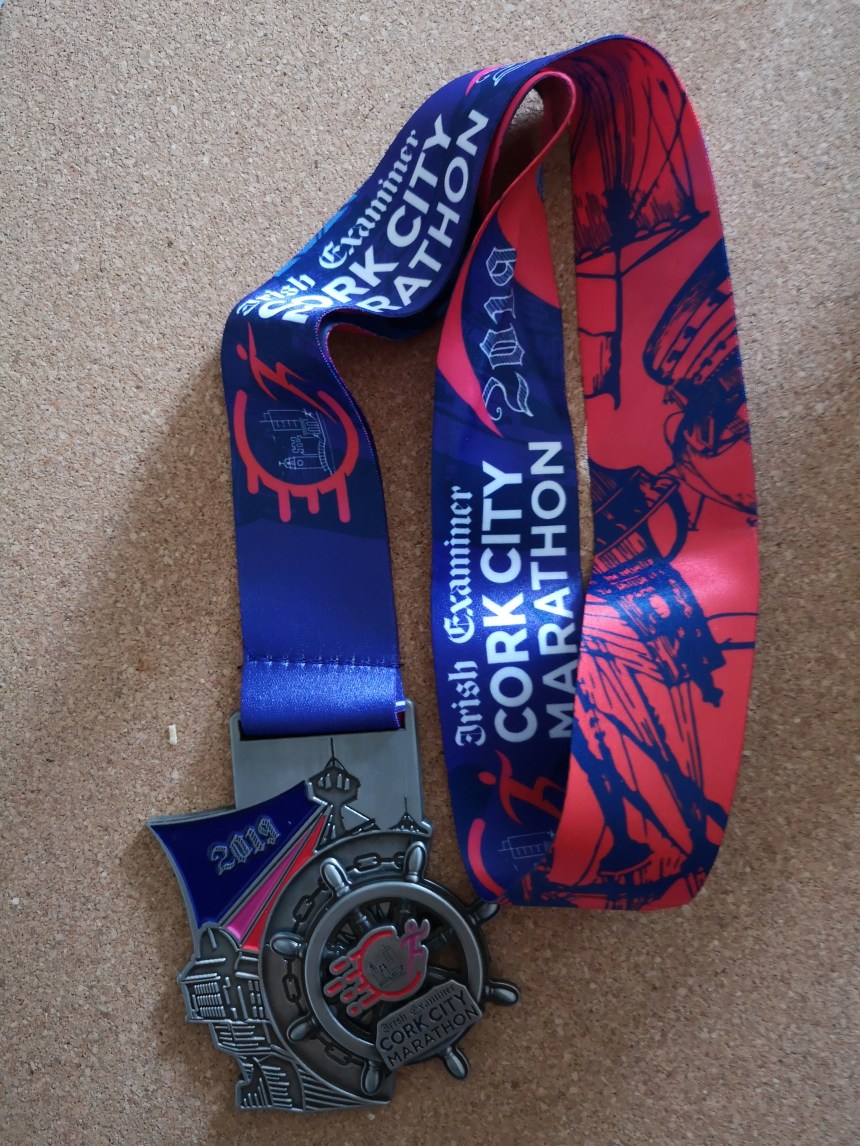
And so I reached the 24 mile (38.647km) marker, and the 25 mile marker (40.258km). I passed the 26 mile marker (41.868km) with people wishing me well. And finally the finish was there, reached at 15:10. I had done it. My first time to participate in a marathon, walking all the way in a net time of six hours and thirty-seven minutes. All .recorded finishers get a medal and I was pleased to collect mine as confirmation of what I had done
My feet were sore, but emotionally I was on a high. I had done something that I was not sure I could do, and in less time than I expected. It was really only after finishing that I began to feel the true pain of blistered feet. Now it is time to nurse those aching feet, and get ready for the next one.
![IMG-8752486b00a81673001981e87bfcf125-V[4546]](https://walkingman.blog/wp-content/uploads/2019/06/img-8752486b00a81673001981e87bfcf125-v4546.jpg?w=860) Strangely, the step count was lower than expected. My step count for the day was 56,122. There were days on the Chemin de St. Jacques that I had higher step counts though I walked shorter distances. I can only conclude that on the city streets my stride is longer. But whether that is true or not is a matter for another day.
Strangely, the step count was lower than expected. My step count for the day was 56,122. There were days on the Chemin de St. Jacques that I had higher step counts though I walked shorter distances. I can only conclude that on the city streets my stride is longer. But whether that is true or not is a matter for another day.
Finally, a linguistic note. I learned a new word at the marathon: “Jeffing” is a mixture of run-walk-run-walk, used by some for long distance events. But it is not for me. I just walk.

 Walkingman
A vivid narrative of the joys and pains of walking, so intricately woven, that the reader imagine and feels what the writer has been through in this real life walking experiences. Thank you for the brief introduction, a legend in history which added to my new learning. You did it Thor! Another feat, you’re a winner! Congrats and more power!
LikeLike
Congratulations Thurloch – well done! You can be truly proud of this walk – and your strong will to succeed.
All the best
Matthias
LikeLike