Last Sunday I went for a walk in Basel. If you have read my previous blog posts, you will know that I like to walk around this city. Usually, I take an extended walk that skirts the city centre, but on Sunday I was thinking that I have not been in Old Basel in quite a while, and it might be nice to take a walk there.
So from my apartment I went to the part of the city that is on the right bank of the Rhine. The locals refer to this part of the city as Kleinbasel, simply because it is smaller, while the part of the city on the left bank of the Rhine is referred to as Grossbasel. Most of Klein Basel is not so old. In fact, there is really only a very small area that could be classed as part of Old Basel. Basel in the middle ages had one of the very few permanent bridges over the Rhine, and Kleinbasel was really just a bridgehead of the city proper, which remained firmly on the left bank of the river.
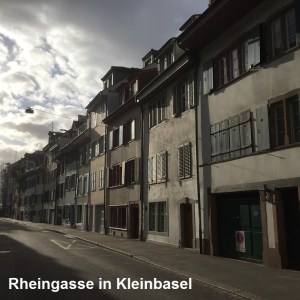
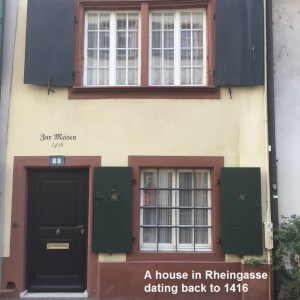
And at this stage, it is necessary to mention one of the cataclysmic events in the history of the city. In 1356, Basel was devastated by an earthquake. As a result, it is very rare to find any buildings older than that date. The oldest street in Kleinbasel is the Rheingasse, where several of the houses have their date of construction over the door. In Rheingasse one sees houses form the early 15th century, but nothing earlier than that.
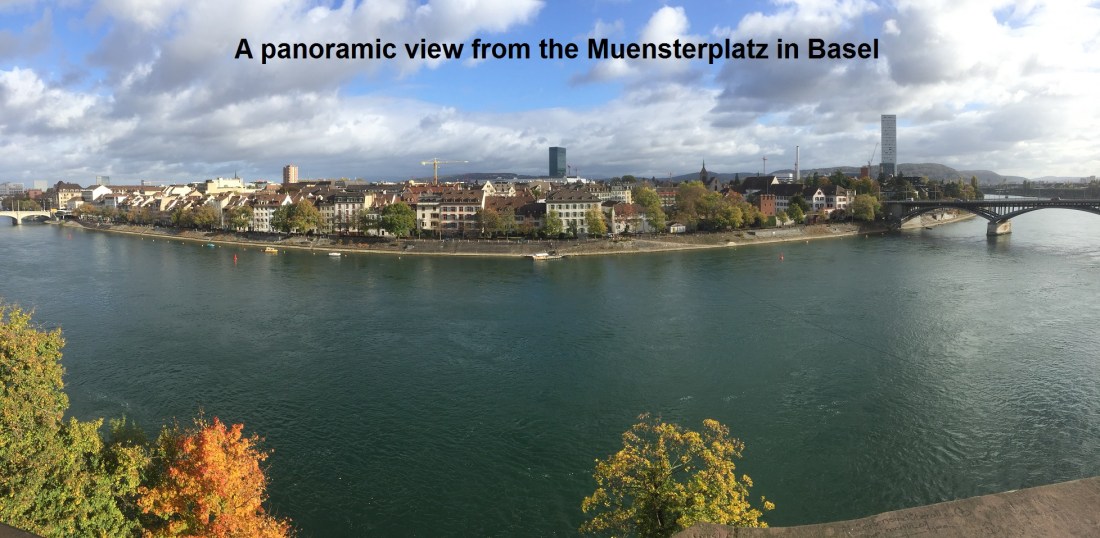
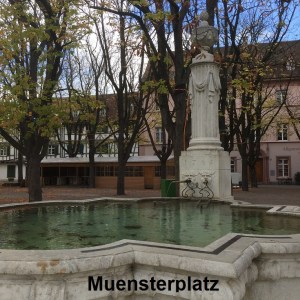
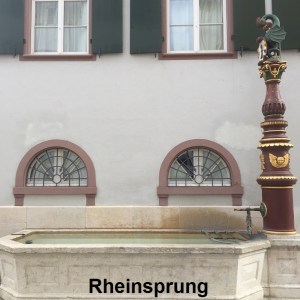
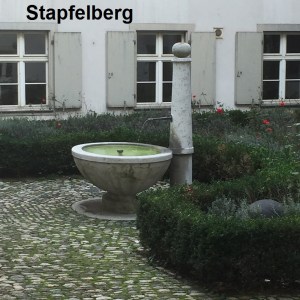
From Rheingasse, my route took me over the Wettsteinbruecke and on to the Muensterberg. Basel does not have a cathedral. It has a minster church, or in German, a Muenster. There has been a church on this site since the 10th century. The Muenster has a commanding view over the river and Kleinbasel, as well as being interesting in its own right. The building is of local red stone which gives it a distinctive appearance. I did not go in on Sunday, but it is worth a visit. The area around the Muenster is a good one to wander in. It is worth letting your curiosity take you down side streets just to see what is there. In another post I mentioned that Basel is a city with many small fountains. Some are clustered close to each other, and the Muensterberg is one of those clusters. I know of five fountains on the Muensterberg, though I cannot say that there are not more. There ae also some nicely decorated houses, again showing their origins in the early 15th century.
Basel is built mainly on two hills: the Muensterberg and the Spalenberg. So after wandering around the side streets of the Muensterberg I descended to the area in between. This is the main commercial are of Basel, with the town hall, the city market square, and the main shopping streets. But again, if you let yourself be taken by curiosity, and wander into those small streets, there are gems to be found. These are streets with old courtyards, antiquarian booksellers, artisan jewelers and such like. In one of the alleys is a curious building with a very official looking symbol over the door to say that it is The Consulate of the Kingdom of Lepmuria. There is no kingdom of Lepmuria, and the building is in fact the home of one of the carnival societies of Basel.

But I will come back to this part of the old city again. It started to rain, and I had to leave my Sunday walk as I was unprepared for the rain. There is more to write about in the old city and I will post here again soon.

 Walkingman