This morning was colder than the previous mornings on my journey. I needed my jacket starting out. It seems the rain of yesterday has ushered in a colder weather system, and in many ways I am grateful for it. Like many of my fellow countrymen, I am not build for the heat of a European summer, and temperatures much in excess of twenty Celsius soon find me withering.
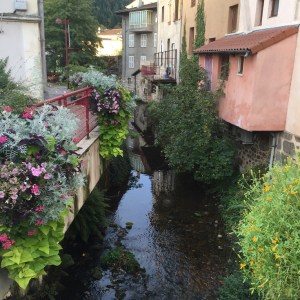
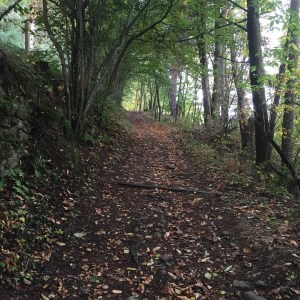
So I left Bourg Argental in the cool of morning at eight o’clock. I was soon headed through the town and out into the forest. Bourg Argental is situated at 556 meters above sea level, so it is not in the lowlands by any means. But my route seemed immediately to be going upwards. First, it was through the usual forests of oak and sweet chestnut. I promise that I will never look at sweet chestnuts in the same way again. In Basel, one of the signs of winter is when street vendors are selling “Heisse Moroni” instead of ice cream. That is their name for roasted chestnuts. Indeed, the idea of chestnuts roasting on an open fire is one of the themes featured in at least one mid-winter carol. But I have seen so many strewn on the ground, left as waste by the locals, ground into the tarmac by passing cars, with only the slugs and snails appreciating their nutrient properties, that I will never look on those Basel street vendors in the same way again.
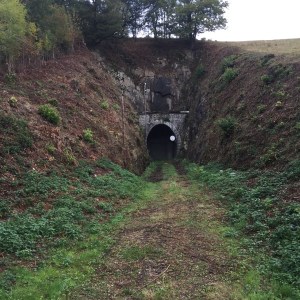
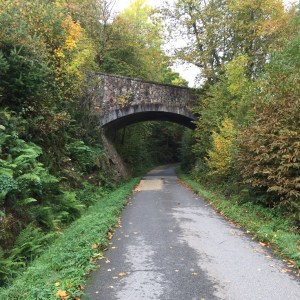
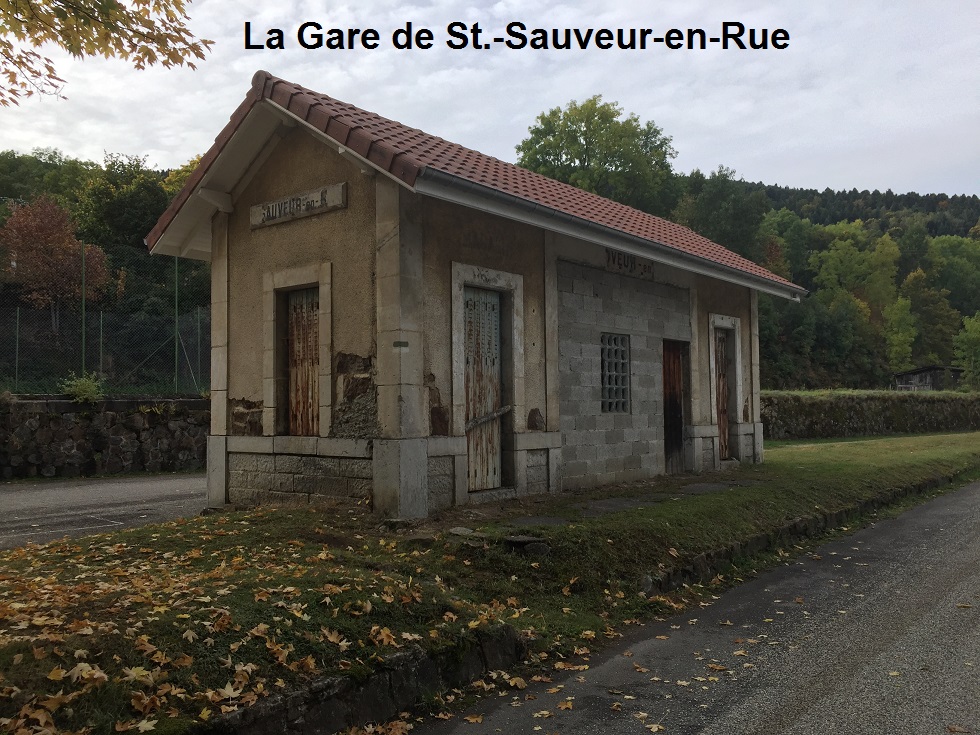
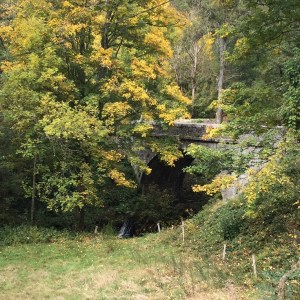
Anyway, the route went upwards through that forest of deciduous trees, and emerged at what one might be forgiven for assuming was a nuclear bunker. It wasn’t. Or at least it wasn’t originally, though it may serve that purpose since then. It was actually the portal of an ancient railway tunnel. At some time in the past, a railway ran here. The route of my walk joined the line of the old railway, and followed it, first as a track, and then as a road. The old bridges are still in place. And being the line of an old railway, there were no outrageous gradients. It was just plain walking until I came to what the guidebook called “La Gare”. As I walked I passed farmhouses hunkered in against the hillside. This was not the orchard country of yesterday, or the cornfield country of a day or two ago. No, these were livestock farms wringing a living from the soil at altitude. 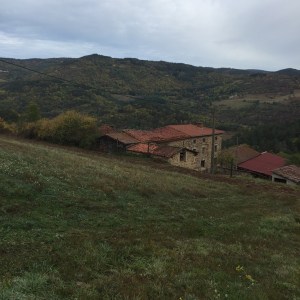
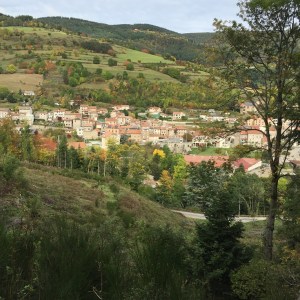
Passing through “La Gare”, I could see the layout of the old station in the road plan. The station house itself has long been converted into a dwelling house, but one of the station buildings still shows signs of its original purpose. I went on through the old station area to where I could see the town it served: St.-Sauveur-en-Rue. Apparently this was a prosperous town in former times, but is not at best just a dormitory town for the nearby city of St.-Etienne. My route continued to follow the old railway line for a short distance before veering off to the left. And it was here I met my first walker of the day.
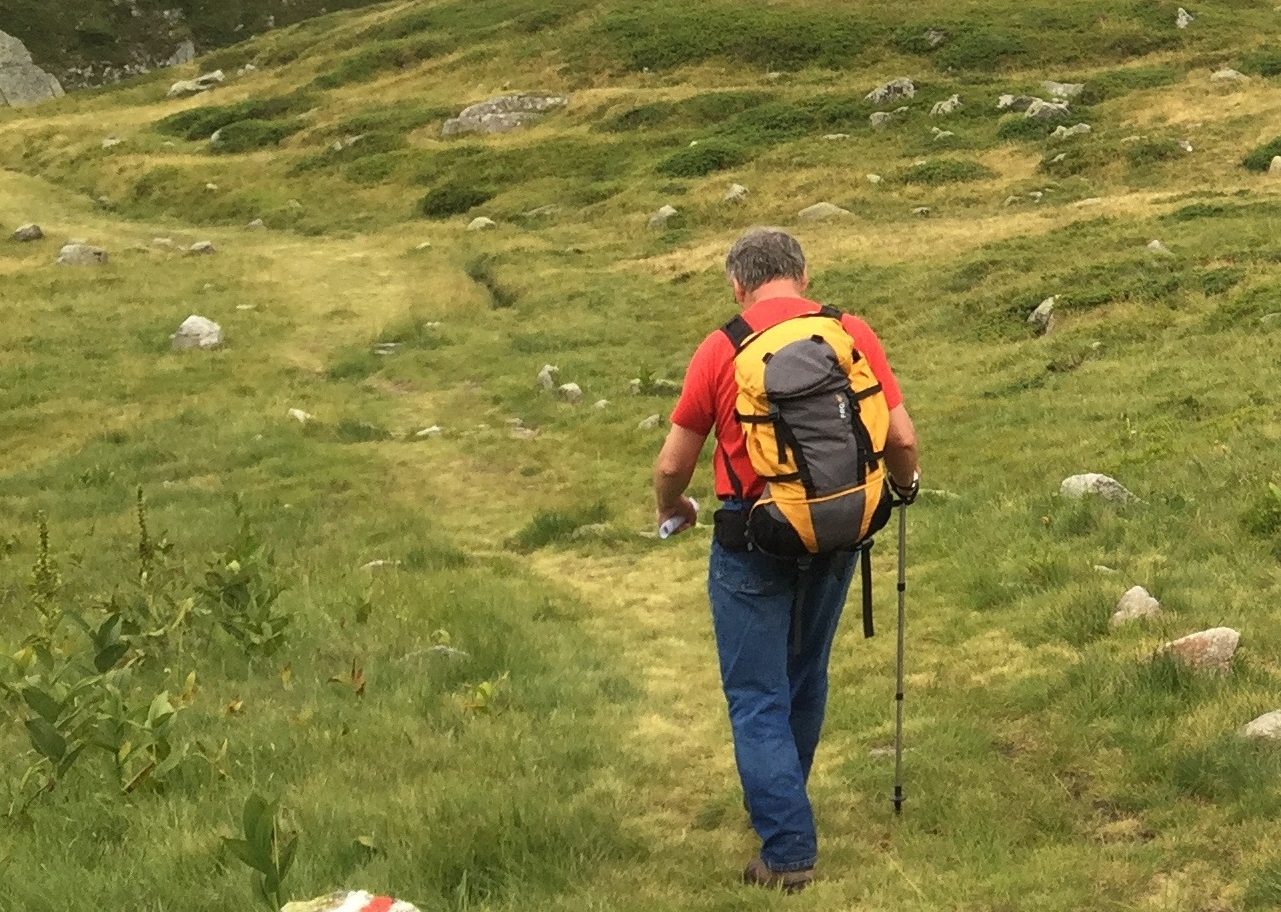
Actually, I do not meet very many fellow walkers. I suppose that the ones going in the same directions as I am have either started before me or after me, and if we all walk at about the same pace we are unlikely to meet during the day. Of course, I meet local walkers every day. They are easily identified by their relaxed air and the absence of a substantial pack on their backs. So when I met a man coming the other way, with a long walking pole and a substantial pack, it was worth taking time to stop and talk. It turned out that he was Polish, walking from a place the other side of Le Puy to his homeland. We chatted a few minutes, wished each other luck, and went on.
The route continued to ascend, and soon I was into forest again. But this was not the forest of oak, walnut and chestnut as before. These were conifers, mostly spruce. I continued onwards, through 800 meters, 900, and eventually passed through 1000 meters above sea level. The route did its best to follow the contours of the mountainside, but it seemed to up and down, mostly up. According to the guidebook, it would bring me through the watershed between the Rhone and Loire river systems. You might expect such a location to be marked by a monument, and an open space with magnificent views to either side. But no, in this case, it was just a point somewhere on the track, and I did not even realise I had passed it until I came to a junction in the track beyond the watershed point.
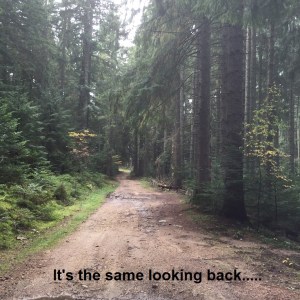
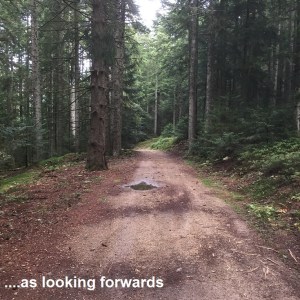
Strangely, the track continued upward, and I was beginning to wonder how long this might go on for, when I saw a sign telling me that I was just a kilometer away from Les Setoux. I have mentioned in these notes how the French villages honour their war dead. But they also honour those from other countries who have fought courageously on their behalf. And so it is in Les Setoux. On August 3rd 1944, the B-24 Liberator “Patsy Jack” was part of a bombing mission on the oil refinery at Le Pontet. They were hit by anti-aircraft fire and realising that they would not make their emergency destination in Corsica, the crew had to bail out. The crew made it out except for one, Sgt. Dandrew, whose parachute failed. The plane itself crashed near Les Setoux. Les Setoux is a small village, but the central square has been named after Sgt. Dandrew, with a plaque in his honour, and a larger memorial to the entire crew of the “Patsy Jack”. The village continues to keep alive its dedication to the brave airmen of that campaign.
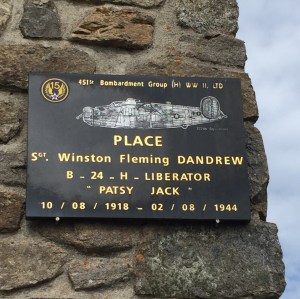
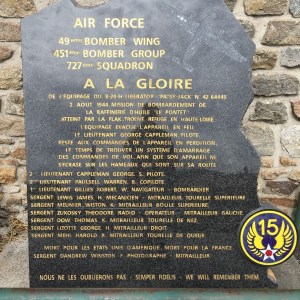
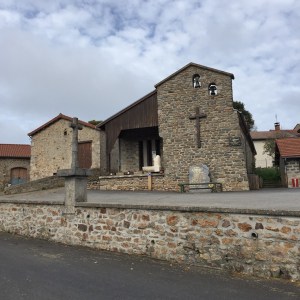
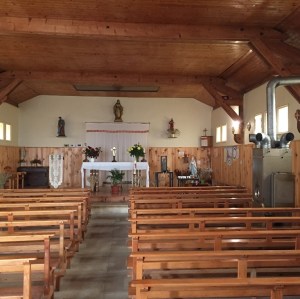
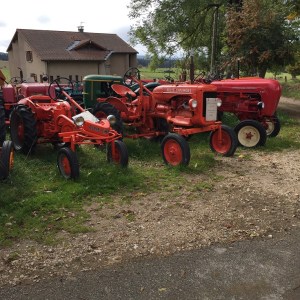
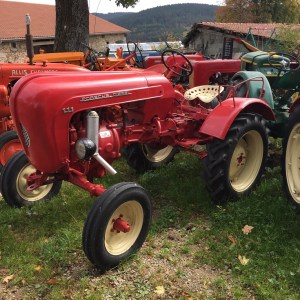
Les Setoux was also important for me in that it provided fresh potable water before going on. It also has a small rustic church, that unlike many in the larger towns was own, and a welcome place to spend a few minutes resting. On the way out of Les Setoux, I passed a farm with a collection of vintage tractors. One in particular reminds us that Porsche, like Lamborghini, was once better known as a maker of tractors than fast cars.
After Les Setoux, the route goes on down to L’hermet, across by Goirolles and Etiennefy before going through more forest to reach Montfaucon. My destination for the day was easy to find, and I am here at the Logis hotel in the town. I have had an excellent dinner, and a good night’s sleep will see me ready for the trail again in the morning. The day has given me two things which I must follow up on when I get back home: that railway line that I followed this morning, and the crew of the “Patsy Jack” What happened to them?
And before I finish, the step count for today: 49,000.

 Walkingman