As you can imagine, I keep a photographic record of most of my walks. I was looking through some of those photographs recently, and I came across photos that brought back memories of one of my favourite walks. The walk in question is not a long all-day walk, but rather a short one that just takes a little over an hour. That is how it is with many of my favourites: they are not especially long, but they have interesting features and memory associations that make them special. Unfortunately, this is is one that I do not often get to do, because it is in County Sligo in Ireland, many many miles from where I currently live in Switzerland.
The walk starts in the townland of Attiduff. When I look up the starting point, it gives a GPS reference of 54; 22; 1.489999 North and 8; 35; 54.869999 West. Actually, it is on the road that goes from the village of Grange towards Magherow. There is a junction at those coordinates, with what Google Maps calls an “Unnamed Road” heading north. You can also find the start point using the reference for the house that stands on the corner of the junction. It has an Eircode (the Irish system of Postcodes or Zip Codes) of F91X7K6, though please do not disturb the good people there.
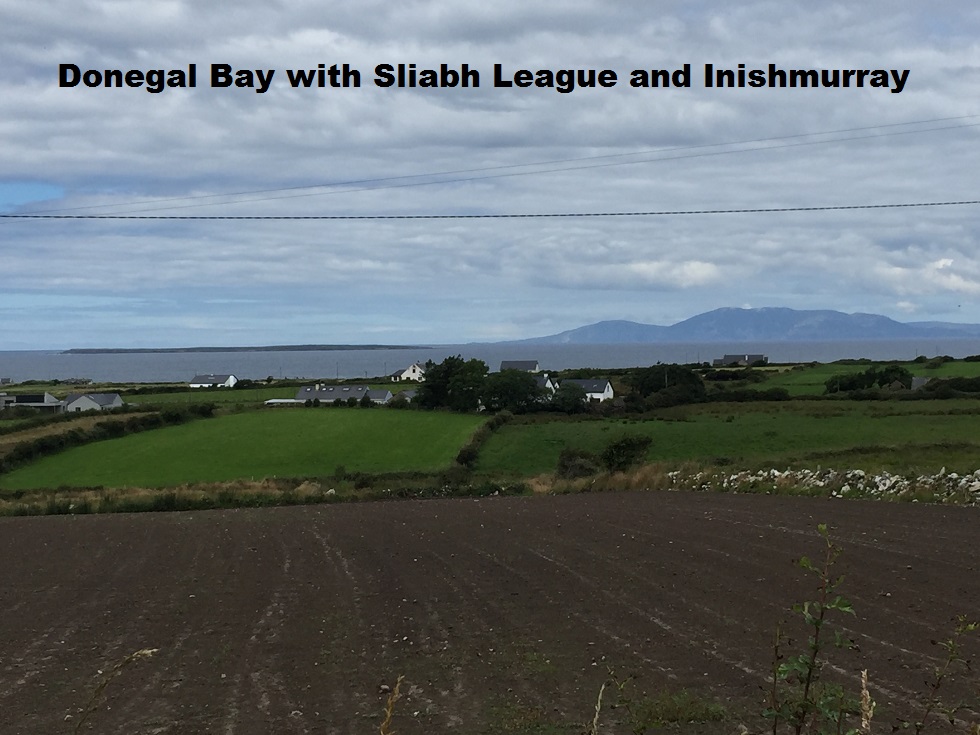
Anyway, my walk takes that unnamed road to the north. It soon goes over a small rise, and then turns left, going down the hill. Once over the rise there are magnificent views of Donegal Bay, with the cliffs of Slieve League, and the low lying island of Inishmurray visible on clear days. Inishmurray was inhabited up until the early 1940s. The story is that the main source of income on the island was the distilling of illegal spirit, and due to the unavailability of sugar during World War 2, the island economy collapsed. The islanders were evacuated in 1942. Today, the remains of their houses stand derelict, alongside the remains of an early Christian settlement. The island is home to colonies of sea birds: gulls, fulmar, and eider to name just a few. There are no trees due to the winds and the ocean, so the island looks completely flat.
My walk continues down the hill to another junction, where it turns right towards the sea. After passing several cottages used by holidaymakers you reach the sea at a small cove, where an embankment of stones sits at the top of a sandy beach. This quiet cove was briefly a busy scene back in 1994 when an oil barge washed up on the shore. Apparently this vessel, a dumb barge loaded with tons of oil, was being towed in the St. Laurence estuary in Canada and broke free. Being full of oil, it sat low in the water and drifted out into the Atlantic. It drifted across to Ireland without hitting any ships. And instead of being dashed on the rocky coast, it drifted in on this sandy beach in Sligo. After a salvage operation, the barge was removed, and the cove returned to its usual quiet.
At low tide, I like to turn right walk eastwards along the beach, but at high tide, it is sometimes necessary to walk along the embankment of stones. A few hundred metres brings the walker to the houses in the townland of Lislary. Many of the houses are new or have undergone major refurbishment, a reflection of Ireland in the 21st century. The walk is back onto roads now, and goes inland from Lislary. It passes some reed beds which were once a valuable source of roofing material for thatching. One of the houses on the road curiously displays a British postbox for their postal deliveries.
The road comes to a crossroads junction, and then my route turns right. It soon comes back to the main Grange to Magherow road, and I turn right again. Then a short walk brings me back to the starting point. On this stretch of the route it is worth looking closely at the stone walls that enclose the small fields; there are some interesting wallflowers and lichens to be seen by the keen observer.
My photos of this walk are all from summer days when the views are magnificent. But I have done it on crisp winter days when the wind is fresh and there is a bite in the air. Unfortunately, I do not get to do this walk as often as I would like, but some day, I must walk it in stormy weather.
And the length of the walk? About 9000 steps, depending on whether you take time to examine the flotsam and jetsam on the beach.

 Walkingman