The Indiana Jones films are well known to a great many people. And the second one in the series, Indiana Jones and the Temple of Doom, contains some thrilling scenes on a rope bridge across a deep gorge. The bridge in the film is not the most secure, with flimsy ropes, and missing planking. So it comes as no surprise in the film that the bridge ends up cut in two, with our hero dangling from one of the pieces. Of course it is the villain who ends up in the river. It is one of the most memorable scenes in the film.
It may come as a surprise to people to learn that there are such bridges in Switzerland. However, being in Switzerland, and in the 21st century, they are not made of ropes, but with steel cables. Nevertheless, they can be a test of one’s head for heights. The Swiss call them Hängebrücken, or hanging bridges
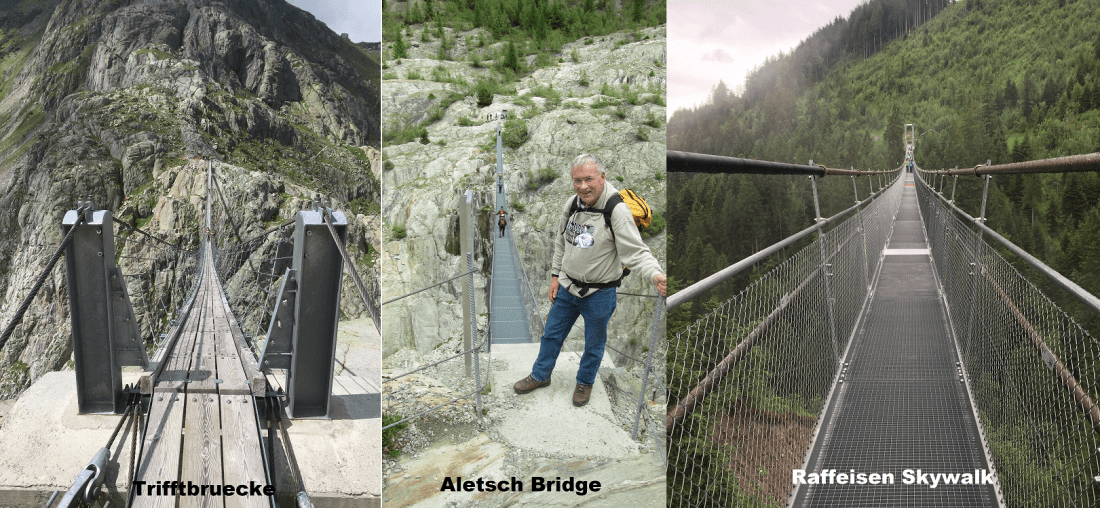
In my walking in Switzerland, I have gone to three of these Hängebrücken. The first was when walking near the Aletsch Glacier two years ago, walking from Bettmeralp to Belalp. Just below the foot of the glacier, where the glacial run-off has carved a gorge deep in the rock, is the bridge. The hanging bridge is 120m long, and is 80m above the roaring stream below. While it is anchored securely at both ends, the middle sways in the wind. And if there are several people on the bridge at one time, the floor of the bridge seems to move up and down with each step. Added to that, the floor of the bridge is a metal grid, the mesh size being about 2cm. So when you look down at your feet, you are also looking straight down into the gorge. As I mentioned, it is a test of one’s head for heights.
But having mastered that, I went looking for another, and last year went to the Trifftbrücke. The route there involved a cable car ride, followed by a 90-minute walk through the high country to the Trifft Glacier. Incidentally, the Trifft Glacier is but a shadow of its former self; it is all but eliminated as a glacier due to global warming. Photos of the glacier from the 1940s show that it has lost over 80% of its size in about 60 years. But to go back to the bridge, it is again placed where the run-off from the glacier has created a gorge in the rocks. I have to say that compared to the previous experience, this one was not such a test of nerves. At 170m long, it is longer than the one at the Aletsch Bridge, and reportedly higher too, at 100m above the stream below. But the floor of the bridge is solid wood, and it is braced with steel cables either side, so that it hardly moves in the breeze, no matter how many people are crossing. All in all, it is much less of a test.
And this year, I went to a third one. The Raffeisen Skywalk at Mostelberg is the easiest of the three to reach. The cable car from Sattel to Mostelberg deposits the walker about 50m from the bridge. And it is the longest of the three: 374m long. The Swiss claim that it is the longest such bridge in Europe, and I have no reason to doubt it. It is 58m above the valley floor. With a lot less side bracing than the Trifftbrücke, it is more like the Aletsch Bridge, but somehow still not as much of a test. Going over and back requires only a small amount of nerves and courage.
So what will I do next year? Well I have heard that a new bridge was opened in Ticino canton last year.
But seriously, it is well worth planning a walk that includes some of the Swiss Hängebrücken. And it gives you a chance to pretend you are the great Indiana Jones.
Oh, and by the way, I did 15,000 steps today
Addendum, August 6th 2017
When I write this piece, the Raffeisen Skywalk was reported tto be the longest Hanging Bridge in Europe. But last weekend, a new Hanging Bridge opened in Wallis Canton in Switzerland. At over 500 metres long, it claims to be the longest int he world. So itt looks like a visit to Wallis will be on the agenda.

 Walkingman