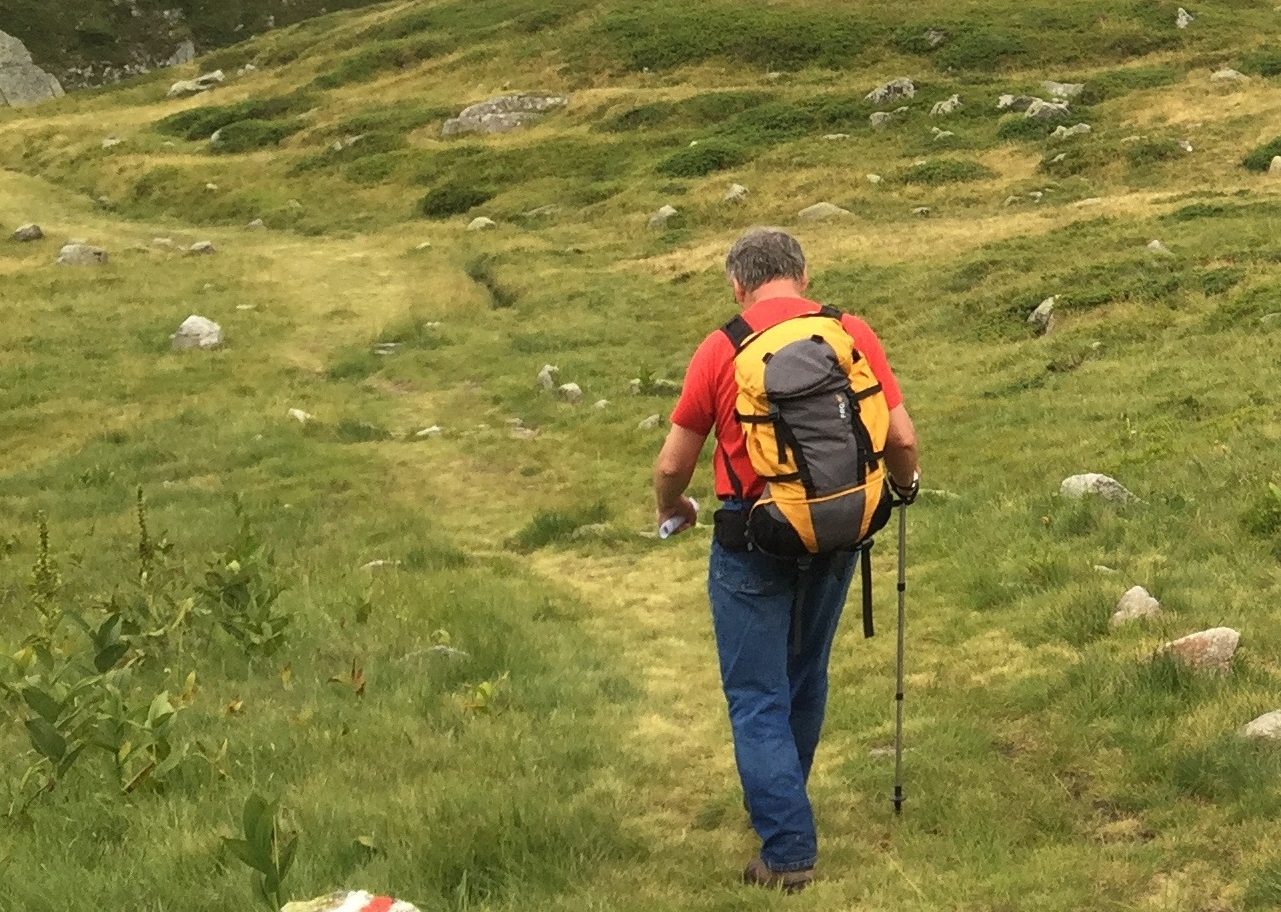

You will regularly hear me say that Switzerland is a walker’s paradise. Much of that is simply down to the good fortune of the country’s geography and fantastic landscapes. But some of it is also down to organisation. There are seven waymarked National Routes in Switzerland, along with over 50 regional routes, and lot more local routes as well. Over the years that I have been here, I have walked large sections of three of the national routes, so last Sunday it was time to explore one of the ones that I was not yet familiar with.
The route in question is the Via Alpina, and it crosses Switzerland, starting in Liechtenstein, and running south-east to reach the shores of Lake Geneva. It goes through six cantons, and includes 14 alpine passes on the way. For this walk, I chose one of the more difficult sections, stage 14, which runs from the little village of Kandersteg to the small town of Adelboden.
An early train brought me to Kandersteg. Even though walking and hiking are very popular in Switzerland, I was still surprised by at the large number people getting off the train in glorious morning sunshine at Kandersteg, all clearly equipped for a day in the mountains. And they all dispersed in many different directions, so that by the time I was out of the village, I was on my own. That first part of the route leaving Kandersteg is level, but I knew that would soon change. From the hamlet of Filfalle, the route ascends through woodland, with occasional fields here and there. The ascent was steady, and in the sunshine, I was soon sweating.
But on reaching the alp at Usser Üschene, the terrain became easier for a short while. Usser Üschene is a classic alpine meadow, with broad pastures for summer grazing, and wooden alpine houses for the residents. By now I had ascended some 400m from Kandersteg (1174m above sea level). It was just a third of the total ascent.
Leaving Usser Üschene, the route zig-zags up the side of the valley. The waymarks are different here. The standard yellow signs used on most routes were left behind, and I found myself following the red and white marking used on alpine routes. In places, this can be tricky, and a walker has to be alert, looking out for the next marker all the time. The route is steep, and ascends another 400m in about one kilometer of distance. I seemed to be heading straight towards the rock wall of the valley, but instead the route used a steep ramp to emerge above the cliffs, reaching 2039m above sea level, more than 800m above my starting point.
From there, there is a section of the route where the ascent is gradual, reaching a second alpine meadow at Alpschele where it is possible to look around and enjoy the scenery. But just after Alpschele comes the most difficult section of the route. I had to cross a field of loose scree. The tracks made by previous walkers had defined the route across the scree, but it was narrow, the scree was loose, and at times each step had to be placed carefully. But after a few zig-zags as the path wove its way through the scree slope, I reached the pass at Bunderchrinde. This is the highest point on the walk, at 2385m above sea level, 800m above my starting point in Kandersteg. It was a good place to rest and enjoy the scenery around me.
The initial descent towards Adelboden is steep, and requires care, but it soon levels out into a grassy alpine meadow, and I was walking comfortably again. On this stage of the route, I saw many wonderful alpine flowers. Gentians I can recognise, but I have to say that most are unfamiliar to me. I can appreciate their beauty, but I don’t know the names.
As I descended through the Bunderle valley, the route soon took me into woodland again. I was glad of the shade it offered, as by now the afternoon sun was very strong. Just before Adelboden, the route crosses the Entschlige River, before ascending uphill into the town. That last ascent was tough, as by then I was almost completely out of energy. But I got there, and was soon waiting at the post office for the bus to start the journey home.
All in all, this was not an especially long walk. But the ascent of 1200m (3937 feet) makes it a demanding one. That, together with the risk and danger on the exposed sections up to the Bunderchrinde, means that it is not one to be taken lightly. Most walks that I describe here could be done by any reasonably fit person, but this one is only for the experienced walker.
And the total distance walked on Sunday? 30,000 steps

 Walkingman